

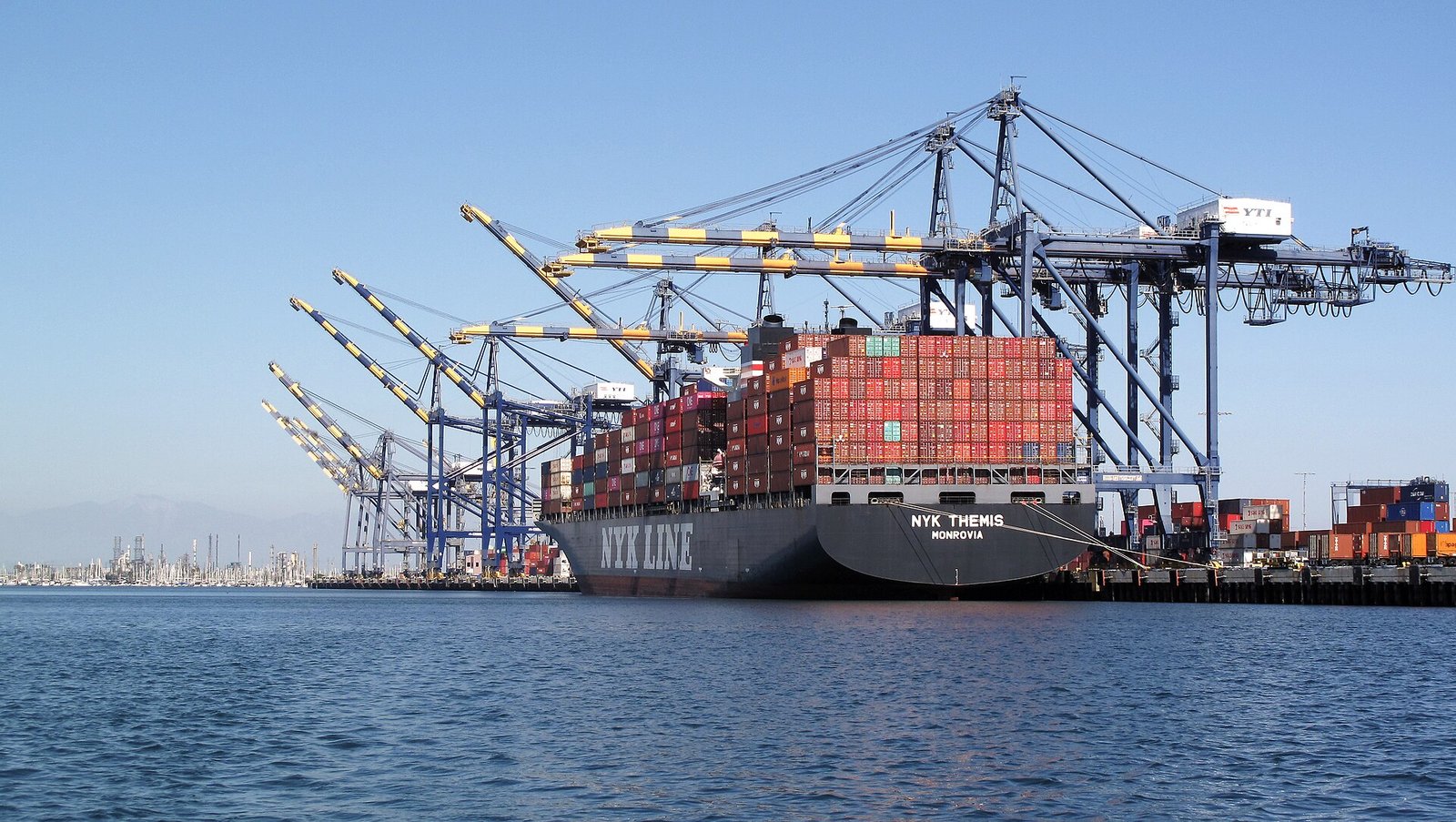
A tariff is a tax — but it is not paid by the country named in the headline. When the United States raises tariffs on Chinese, Canadian or European goods, no foreign government sends Washington a cheque. The bill lands at the US border, paid to US Customs by the American-side importer, and ends up in the price of everything from cars to kettles. Here is how tariffs work, who really pays them, and — dated, because the rates kept changing — what is in force now.
Where things stand (November 3, 2026): the “reciprocal” tariffs of 2025 are gone — struck down by the Supreme Court in February 2026, with ~$150 billion collected under them being refunded to importers. What remains: Sections 301 and 232, used harder, and the end of duty-free parcels.
Key points
- A tariff is a tax on imported goods, set product by product in the US tariff schedule, collected by Customs and Border Protection (CBP) at entry — and legally paid by the importer of record. Foreign exporters never pay the US Treasury.
- Economically, New York Fed research found nearly 90% of the 2025 tariffs’ burden fell on US firms and consumers.
- Presidents act only under specific laws — Section 232 (national security), Section 301 (unfair practices), Section 201 (import surges), Section 122 (payments emergencies). The 2025 tariffs built on a fifth law, the emergency statute IEEPA, were struck down by the Supreme Court in February 2026.
- There is no single “current US tariff rate”: CBO puts the average effective rate at roughly 7%, up from ~2.5% in 2024.
What is a tariff?
A tariff, or customs duty, is a tax charged on goods as they enter a country. Every imported product sits on a line of the Harmonized Tariff Schedule of the United States (HTSUS), and each line carries a rate. Most US rates are ad valorem — a percentage of the goods’ customs value; some are specific (a fixed amount per kilo or litre). The standard Column 1 (“most-favoured-nation”, MFN) rate applies to nearly all partners; the extra duties in the news are added on top, in Chapter 99.
Governments levy tariffs to raise revenue (the original purpose), to protect domestic producers by making imports dearer, and as leverage in disputes. Measured across all US imports, the average duty collected was only about 2.5% in 2024, per the Congressional Budget Office (CBO); the tariffs of 2025–26 pushed it sharply higher.
Who actually pays it?
Legally, the answer is unambiguous. Under US customs law (19 U.S.C. §1484), the importer of record — the owner or purchaser of the goods in the United States, or a licensed broker acting for them — must file the entry, exercise “reasonable care,” and pay the duties to CBP. The foreign factory owes the US government nothing, and hiring a broker does not move the liability: if the duty is wrong or unpaid, CBP collects from the importer.
Who ends up bearing the cost is a different, economic question. An importer facing a 25% duty can absorb it, raise prices, or squeeze the foreign supplier’s price — the only route to the exporting country. How that split fell in 2025 is measured below.
2026 proved the point in court: the voided duties were ordered refunded to the importers of record who had paid them — about $150 billion, with interest, per CBO. Shoppers who had paid higher prices had no claim: in customs law, they never paid a tariff.

The main US tariff laws
The Constitution gives the tariff power to Congress (Article I, Section 8); every modern tariff is a president acting under a statute Congress passed, each with its own trigger, investigating agency and limits. The Congressional Research Service (CRS) summarises the five authorities that matter:
| Law | What triggers it | Who must find the facts | Rate cap | Time limit | Best-known use |
|---|---|---|---|---|---|
| Section 232, Trade Expansion Act of 1962 | Imports threaten national security | Secretary of Commerce (report due within 270 days) | None | None | Steel and aluminium, 2018– ; automobiles, 2025– |
| Section 301, Trade Act of 1974 | A foreign practice is unjustifiable or unreasonable and burdens US commerce | US Trade Representative (USTR) | None | Reviewed every 4 years; can continue indefinitely | Tariffs on China, 2018– ; forced-labour action, 2026– |
| Section 201, Trade Act of 1974 | An import surge is a substantial cause of serious injury to a US industry | International Trade Commission (ITC) | +50 percentage points (with phasedown) | 4 years, extendable to 8 | Solar cells and washing machines, 2018 |
| Section 122, Trade Act of 1974 | A large, serious balance-of-payments problem | None — presidential proclamation | 15% | 150 days | Worldwide 10% surcharge, Feb–Jul 2026 |
| Section 338, Tariff Act of 1930 | A country discriminates against US commerce | President (ITC advises) | 50% | None | Never used to impose tariffs |
One law is missing from the table because the courts removed it. The International Emergency Economic Powers Act (IEEPA) of 1977 — an emergency sanctions law — was used in 2025 for the “fentanyl” tariffs on Canada, Mexico and China and then for the worldwide “reciprocal” tariffs. Importers sued, arguing Congress never gave the president a tariff power in that text — one of several challenges, including a lawsuit over the tariffs on Canadian imports. On February 20, 2026, the Supreme Court held 6–3 in Learning Resources, Inc. v. Trump that IEEPA does not authorise tariffs, and collection stopped four days later. IEEPA remains a sanctions law only.
Tariffs in force now (November 2026)
Snapshot dated November 3, 2026. In 2025–26 US rates changed every few weeks; any rate below can be amended by proclamation or Federal Register notice. For a specific product, check its HTSUS Chapter 99 headings on the day of entry. Each line below sits on top of the ordinary MFN duty.
- Section 301 on China (since 2018). Four lists from the China technology-transfer investigation: Lists 1–3 at 25%, List 4A at 7.5%. A 2024 review raised strategic lines sharply — 100% on Chinese EVs, 50% on semiconductors and solar cells — in stages through January 2026. USTR continued the actions in October 2026.
- Section 301 “forced-labour” duties (since July 24, 2026). From 60 investigations into economies that fail, in USTR’s finding, to ban forced-labour goods: 10% on 17 economies including Canada, Mexico, India and the United Kingdom; 12.5% on 38 others including China and Vietnam; for the EU, Taiwan, Japan, South Korea and Switzerland, a top-up capping the combined duty at 10% or 12.5%. Goods already paying Section 232 duties are exempt.
- Section 232 sector duties. Steel, aluminium and copper: 50% on primary products, 25% on derivatives, on the full customs value since April 2026 (UK steel: 25%). Cars and listed parts: 25%, with arrangement rates (15% total for EU/Japan/Korea-built cars; 10% for UK cars within a 100,000 quota). Trucks 25%, buses 10%; lumber 10%; furniture and kitchen cabinets 25%, rising in January 2027 — plus further sector programmes added during 2026.
- Not in force: the IEEPA tariffs (void since February 2026; refunds under way) and the Section 122 surcharge (expired July 24, 2026).
- Parcels. The $800 de minimis exemption is suspended for every country (2025–26) and repealed outright from July 1, 2027.
- The total. CBO puts the average effective rate at about 7% — roughly triple 2024, well below the 2025 peak (13%).
Other countries have answered in kind and in negotiation: Canada announced reciprocal tariffs after US–Canada talks collapsed; Brazil has weighed retaliatory options; Washington has warned India over tariffs linked to Russian oil; and Ottawa has signalled progress in trade-deal talks.
What tariffs do to prices — the evidence
The best measurement of the 2025 experiment comes from the Federal Reserve Bank of New York. Amiti and co-authors found the average tariff on US imports rose from 2.6% to 13% during 2025, and that nearly 90% of the economic burden fell on US firms and consumers: foreign exporters barely cut their prices (in the first eight months, a 10% tariff lowered export prices by only 0.6 points). Their study of the 2018–19 tariffs found pass-through of essentially 100% — why the economic impact of the US–Canada trade war showed up in shelf prices, not foreign treasuries.
One 2026 study pushes back: weighting trade by value, CEPR researchers found the largest exporters absorbed much more by cutting prices, so average landed import prices rose far less than the tariff. Both can be true (small exporters pass through; giants absorb), but the weight of evidence says most of a US tariff is paid inside the United States — and CBO estimates the 2025 increases temporarily raised inflation and lowered real GDP. Higher inflation is also what has kept the Federal Reserve raising rates in 2026 — see how the Fed affects interest rates.
A short history
- 1789 — Among Congress’s first laws; duties supply most federal income for a century.
- 1890 — The McKinley Tariff pushes the average dutiable rate to about 48%, the high-water mark of 19th-century protection.
- 1930 — Smoot-Hawley (the Tariff Act of 1930; its Section 338 is still law) raises rates into the Depression; partners retaliate, world trade collapses.
- 1934 — The Reciprocal Trade Agreements Act reverses course: presidents may cut rates by up to half for matching cuts abroad.
- 1947 — The US signs the GATT; negotiating rounds drive average rates down for decades.
- 1962 / 1974 — The Trade Expansion Act and Trade Act hand presidents the standby tools — Sections 232, 201, 301, 122 — that sat mostly idle and now carry almost all US tariff policy.
Tariffs vs quotas vs sanctions
All three restrict trade, but differently. A tariff is a price tool: trade continues, each unit pays a tax, and the revenue goes to the importing government. A quota is a quantity tool: imports are capped at a fixed volume (a tariff-rate quota mixes the two — lower duty inside the cap, higher above it), and the scarcity value flows to import-rights holders or foreign exporters, not the Treasury. An embargo is a quota set to zero. Sanctions are broader: asset freezes, export controls and financial cut-offs aimed at changing a government’s behaviour, run by the Treasury’s OFAC under laws such as IEEPA. Since February 2026 the line is sharper: sanctions remain an emergency power; tariffs do not.
Frequently asked questions
Who pays a tariff — the foreign country or Americans?
The importer of record pays US Customs — never the foreign government. Economically, the New York Fed found nearly 90% of the 2025 burden fell on US firms and consumers, as exporters cut prices only slightly.
What is the current US tariff rate?
There isn’t one. Duties stack by product and origin: an MFN base rate plus Section 301 and/or 232 additions. Across all imports, CBO puts the average effective rate at about 7% since February 2026, up from ~2.5% in 2024.
Are the 2025 “reciprocal” tariffs still in effect?
No. The Supreme Court struck them down on February 20, 2026; the ~$150 billion collected (per CBO) is being refunded to importers of record. Parts were rebuilt under other laws (Section 122, expired July 2026; Section 301 forced-labour duties, in force since July 2026).
How much money do tariffs raise?
About $300 billion was collected in January 2025–February 2026 alone, roughly half under the since-voided IEEPA orders. CBO projected in November 2025 that the tariffs then in place would cut deficits by ~$3.0 trillion over a decade; ending IEEPA added back ~$2.0 trillion.
Can I still import parcels under $800 duty-free?
No. The de minimis exemption is suspended for all countries (2025–26) and repealed from July 1, 2027. Every parcel now needs an entry and pays duty.
Sources
- Congressional Research Service — Congressional and Presidential Authority to Impose Import Tariffs (R48435, updated March 19, 2026): https://www.hsdl.org/c/view?docid=900961
- Congressional Research Service — Section 232 Investigations: Overview and Issues for Congress (R45249): https://www.everycrsreport.com/reports/R45249.html
- Congressional Budget Office — An Update About CBO’s Projections of the Budgetary Effects of Tariffs: https://www.cbo.gov/publication/62210
- Congressional Budget Office — CBO’s Updated Projections of the Budgetary Effects of Tariffs as of November 15, 2025: https://www.cbo.gov/publication/61877
- Federal Reserve Bank of New York, Liberty Street Economics — “Who Is Paying for the 2025 U.S. Tariffs?” (February 12, 2026): https://libertystreeteconomics.newyorkfed.org/2026/02/who-is-paying-for-the-2025-u-s-tariffs/
- CEPR — “Tariff Incidence and Market Power: Evidence from the 2025 US Tariff Shock” (Discussion Paper 21798, VoxEU summary): https://cepr.org/voxeu/columns/foreign-exporters-absorbed-nearly-half-2025-us-tariff-shock
- US Trade Representative — Notice of Action, Section 301 Forced-Labour Investigations, 91 FR 47318 (July 28, 2026), summarised by PwC Tax Insights: https://www.pwc.com/ca/en/services/tax/publications/tax-insights/section-301-tariffs-aug-2026.html
- The President — Proclamation 11012, Imposing a Temporary Import Surcharge To Address Fundamental International Payments Problems, 91 FR 9339 (February 25, 2026)
- US Customs and Border Protection — CBP modernizes low-value shipment processing: https://www.cbp.gov/newsroom/national-media-release/cbp-modernizes-low-value-shipment-processing
- US Code — 19 U.S.C. §1484 (entry of merchandise; importer of record), as summarised at: https://legalclarity.org/who-pays-import-tariffs-the-importer-of-record/