
As President Trump hosts Xi Jinping for high-stakes trade talks in Washington, NASA continues its global expansion through new international space partnerships.
The convergence of high-stakes geopolitical negotiations and landmark advancements in space exploration underscores a pivotal moment for the United States. As Washington hosts President Xi Jinping for the first such state visit in over a decade, the backdrop of these discussions is not merely domestic economic policy, but the global contest for technological and scientific hegemony. The concurrent expansion of the Artemis Accords and the operational commencement of the Nancy Grace Roman Space Telescope highlight a strategic shift: the U.S. is seeking to cement a coalition of international partners committed to standardized, transparent exploration, even as it navigates deep-seated friction with Beijing over trade and regional security.
President Donald Trump and First Lady Melania Trump welcomed Chinese President Xi Jinping and his wife, Peng Liyuan, at Joint Base Andrews on Wednesday in a rare display of personal diplomatic reception. The visit, which includes a ceremonial White House welcome featuring nearly 500 military personnel, serves as the stage for critical discussions regarding the future of U.S.-China economic relations. A primary focus is the extension of a trade truce, originally set to expire in November, which has now been pushed to January 10. This buffer provides negotiators with a narrow window to address systemic tensions, though the agenda remains fraught with complexities ranging from the U.S.-Israel war on Iran to the strategic status of Taiwan.
The summit's guest list for the state dinner underscores the administration's emphasis on technological dominance, with corporate leaders from Apple, Nvidia, and OpenAI expected to attend. Despite the high-profile nature of the talks, both governments have opted against a joint news conference. Instead, the two nations plan to release individual statements, reflecting the difficulty of finding common ground in an era of heightened strategic competition. The visit is scheduled to conclude Friday with an informal tea at the White House and a tour of the National Archives.
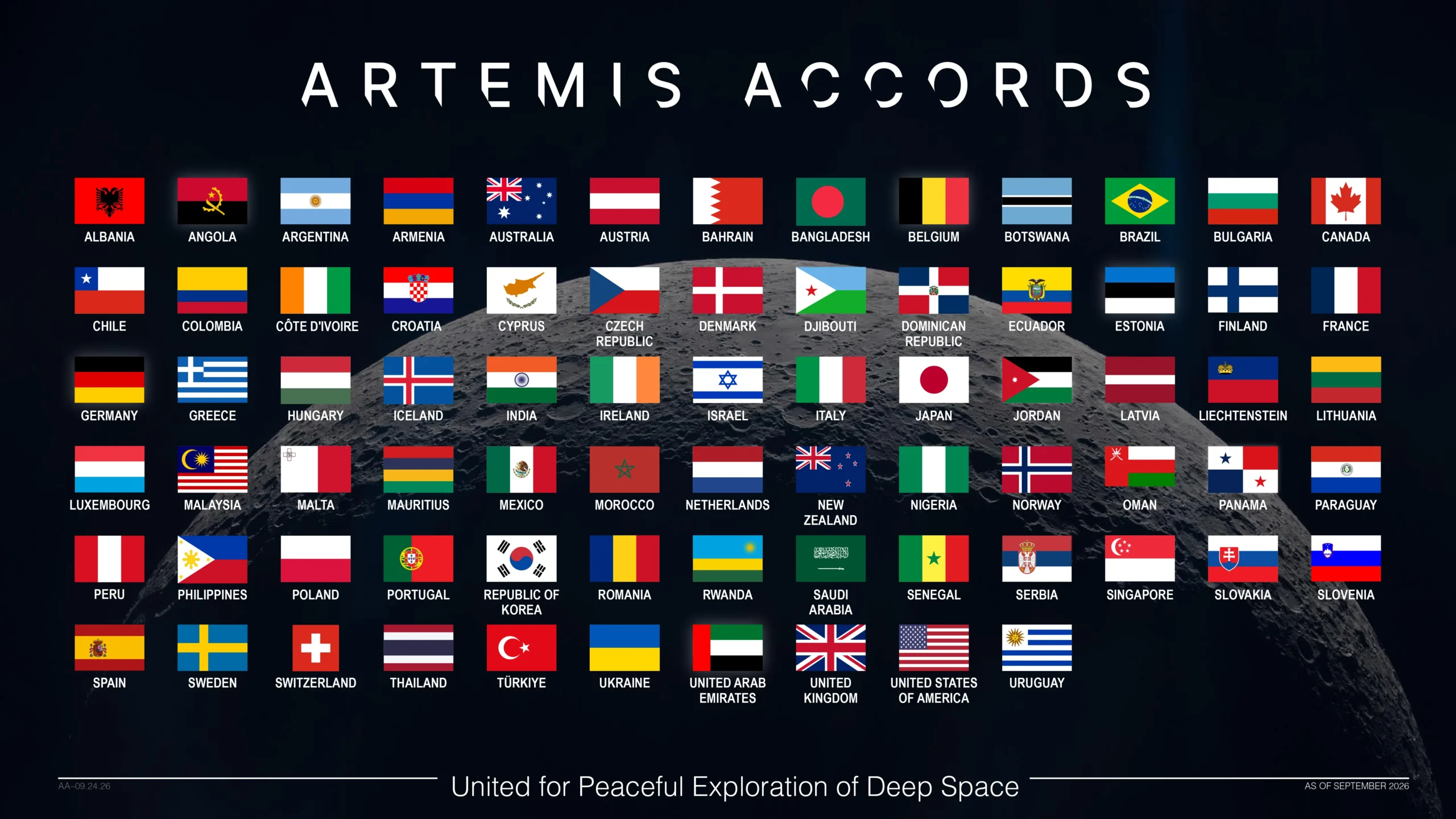
While diplomatic efforts occupy the capital, the American scientific community is currently navigating a period of significant achievement. NASA recently confirmed Côte d’Ivoire as the 75th signatory to the Artemis Accords, an international framework governing the responsible exploration of the Moon and beyond. The signing, held at the Africa Space Expo in Abidjan, marks a notable expansion of U.S.-led space cooperation on the African continent, building on long-standing partnerships in Earth observation and geodesy. NASA Deputy Administrator Matt Anderson characterized the move as a transition from terrestrial cooperation to deep-space collaboration.
Simultaneously, the agency is adjusting to a new era of observation with the Nancy Grace Roman Space Telescope. Having successfully launched from Kennedy Space Center on a SpaceX Falcon Heavy rocket, the telescope is now on a 100-day journey to a vantage point one million miles from Earth. Astronomers anticipate that the telescope's expansive field of vision, which is 100 times greater than that of the Hubble or James Webb telescopes, will lead to the discovery of up to 100,000 new exoplanets. As the Roman telescope prepares to chart the "dark universe," the aging Hubble continues to provide data, recently revealing a unique galactic anomaly in NGC 4698, a spiral galaxy where the center rotates perpendicular to its outer disk.
The immediate outlook hinges on whether the extended January 10 deadline for trade negotiations produces a substantial policy shift or merely delays potential economic volatility. Given the separate messaging strategies announced ch side characterizes the outcomes of the summit regarding AI policy and regional conflicts. In the scientific sector, the focus will shift to the successful arrival of the Roman telescope at its orbit, roughly four times the distance of the Moon, followed worlds beyond our solar system.