

On October 28, the Federal Reserve held its benchmark rate steady — and the next morning, the average 30-year mortgage rate fell anyway. That is not a contradiction; it is the whole story of how the Fed affects interest rates. The Fed directly controls one rate — an overnight rate most people never see. Every other rate takes its cue from it through a different route, at a different speed, and sometimes in the opposite direction. Here is how each route works, what the Fed has done in 2026, and when it decides next.
Where things stand (November 3, 2026): the target range is 3.75% to 4.00% — raised there in September, held in October. The average 30-year fixed mortgage rate is 7.24% (Freddie Mac, week ending October 29).
Key points
- The Fed sets a target range for the federal funds rate — the overnight rate banks charge each other. It does not set mortgage rates, credit-card APRs or savings rates.
- The current range, 3.75%–4.00%, was set by a quarter-point rise on September 16, 2026 and held on October 28, when two policymakers dissented in favour of another increase.
- Mortgage rates follow the 10-year Treasury yield plus a spread, not the Fed directly — which is why they eased the week the Fed stood still.
- Floating-rate borrowing — most credit cards and home-equity lines — reprices quickly after a Fed move. Savings rates follow more slowly and rarely in full; fixed loans you already hold never change.
- The FOMC meets eight times a year; next is December 8–9, 2026, with new economic projections.
What is the federal funds rate?
Banks hold reserve balances at the Federal Reserve to settle payments. Banks with a surplus lend them overnight to banks that need them — and the interest rate on those loans is the federal funds rate.
The Fed does not dictate the rate trade by trade. Since December 2008 it has announced a target range, a quarter of a percentage point wide, and steered the market rate inside it — mainly through the interest it pays banks on reserve balances. A bank is unlikely to lend to anyone for less than it can earn risk-free on reserves at the Fed, so that rate anchors the whole overnight market. When headlines say “the Fed raised rates by a quarter point,” this range is what moved — usually by 25 basis points at a time.
Who decides — the FOMC and its 2026–27 meeting calendar
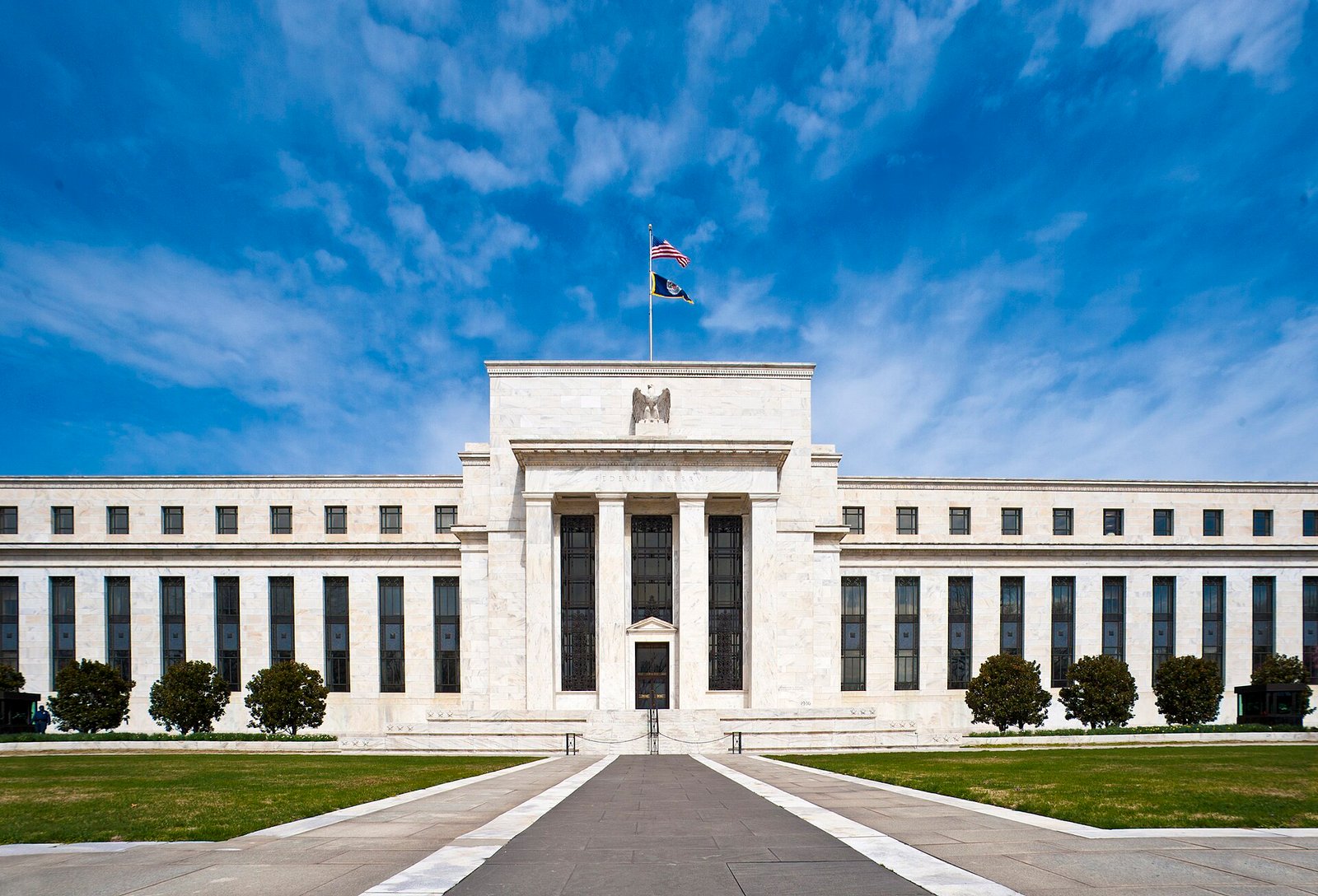
The decision belongs to the Federal Open Market Committee (FOMC): the members of the Fed’s Board of Governors, the president of the Federal Reserve Bank of New York, and four of the other eleven Reserve Bank presidents, rotating in for one-year voting terms. All twelve presidents attend; twelve members vote. The Committee meets eight times a year, announces its decision at 2 p.m. Eastern on the second day, and publishes minutes three weeks later. At four meetings a year (marked *) it also publishes a Summary of Economic Projections — the “dot plot” of where each policymaker expects rates to go.
| 2026 meetings | 2027 meetings |
|---|---|
| January 27–28 | January 26–27 |
| March 17–18* | March 16–17* |
| April 28–29 | April 27–28 |
| June 16–17* | June 8–9* |
| July 28–29 | July 27–28 |
| September 15–16* | September 14–15* |
| October 27–28 | October 26–27 |
| December 8–9* — next | December 7–8* |
Tentative until confirmed at the preceding meeting (Federal Reserve calendar).
One change is coming. At his October 28 press conference, Chair Kevin Warsh — whose shorter statements and no-forward-guidance approach our coverage of Chair Warsh signalling policy shifts has tracked — announced that starting next fall, one 2027 meeting will be devoted exclusively to broad policy strategy, with no rate vote and no policy statement; he expects two such meetings in 2028. Which meeting changes format has not been announced.
The rate now (November 2026)
This section is dated November 3, 2026, and is refreshed after every FOMC meeting.
The Fed’s 2026 has been a tightening year. On September 16, the FOMC raised the target range by a quarter point to 3.75%–4.00%, unanimously — the move our Business desk covered as the first interest rate hike in three years. On October 28 it held the range there, 10 votes to 2: Governor Lisa Cook and Cleveland Fed president Beth Hammack wanted another rise instead. The statement described activity as “expanding at a strong pace,” said “inflation remains elevated” — consumer prices rose 3.7% in the year to September (CPI) — and promised “the Committee will deliver price stability.”
Where next? Policymakers’ September projections put the median expected rate at 4.1% at the end of 2026 — above today’s range, and consistent with one more quarter-point increase — but projections are forecasts, not commitments, and the September minutes record only that most participants judged another increase “likely appropriate” by year end, depending on the data. Updated projections arrive with the December 8–9 meeting. One upward pressure on prices comes from trade: see our explainer on what tariffs do to prices.
Why your mortgage does not simply follow the Fed

If the Fed sets “interest rates,” why is the average mortgage at 7.24% when the Fed’s rate is under 4% — and why did it fall the week the Fed refused to cut?
Because a 30-year mortgage is not priced off an overnight rate. Lenders and mortgage-backed securities (MBS) investors price it off long-term money: J.P. Morgan Asset Management’s research calls the 10-year Treasury yield “the key building block for the 30-year mortgage rate,” with a mortgage spread added on top — one part paying originators and servicers, one part compensating MBS investors for prepayment and credit risk. That spread, tracked in the St. Louis Fed’s FRED data, has recently run at about 2.2 percentage points, against a long-run average of about 1.75 since 1971.
The Fed’s own explanation of the link is about expectations: long-term rates reflect where investors think policy and the economy are heading over the life of the loan, not where the funds rate sits today. That is why mortgage rates move on inflation reports, jobs data and Fed speeches — sometimes weeks before a meeting — and why a widely expected decision, like October’s hold, can change nothing on the day. It is also why the Fed has a second lever: in crises it has bought Treasury and mortgage-backed securities in size (quantitative easing), pushing long-term rates down directly; running those holdings off does the opposite. Freddie Mac’s weekly survey — 7.24% for the week ending October 29, 2026, down from 7.32% and up from 6.17% a year ago — is the benchmark to watch; it covers conventional purchase loans for borrowers with 20% down and excellent credit, so your quote will differ.
What Fed moves do to your money — savings, cards and loans

- Credit cards — fast. Most card APRs are variable and indexed to the prime rate, which banks set directly off the Fed’s target. A quarter-point move typically shows up within one or two billing cycles, in both directions — the Fed’s transmission guide notes that floating-rate loan and credit-line rates reflect target changes rapidly.
- Home-equity lines and adjustable-rate mortgages — fast. Floating-rate by design; they reprice on the same logic as cards.
- Savings accounts and CDs — slow, and partial. No rule forces a bank to pass a Fed move on to depositors. Savings rates follow the funds rate with a lag and usually by less than the full move; online high-yield accounts adjust fastest. New CDs price off the new environment; existing CDs are locked.
- Auto loans — gradual, and only on new loans. Fixed-rate and priced off intermediate Treasury yields and funding costs, so they drift with the bond market, not decision day. A loan you already have never reprices.
- Fixed-rate mortgages — only via the market. New quotes move with the 10-year yield and spreads, sometimes before the Fed acts at all.
The pattern: the closer a product sits to overnight money, the faster and fuller the Fed’s move arrives. “Higher for longer” suits savers in high-yield accounts and punishes anyone carrying a card balance; a cutting cycle reverses both.
The dual mandate in plain English
Congress has given the Fed two jobs — the dual mandate: maximum employment and stable prices (the Act adds “moderate long-term interest rates,” treated as the product of the first two). Price stability has a number: the FOMC judges 2% inflation, measured by the PCE price index, most consistent with both goals over the longer run. Maximum employment deliberately has no number — the Fed says the highest sustainable level of jobs depends on things monetary policy cannot control.
The two jobs pull against each other, and 2026 is a live demonstration. Cutting rates would support jobs but risks entrenching inflation still above target — one reason US inflation proving persistent has kept the Committee tightening instead. The same inflation lands in household budgets too: it sets the Social Security cost-of-living adjustment — 2.8% for 2026 — detailed in our 2026 Social Security payment schedule. Every FOMC decision is a judgement about which side of the mandate is in more danger.
Frequently asked questions
Does a Fed rate cut lower mortgage rates?
Not directly, and not always. Mortgage rates are set by the bond market off the 10-year Treasury yield plus a spread. A cut markets already expect is usually priced in beforehand; a cut that signals worse inflation ahead can even push long-term yields — and mortgage rates — up. October 2026 showed the reverse: the Fed held, and the average 30-year rate still fell to 7.24%.
When is the next Fed meeting?
December 8–9, 2026, with the decision announced at 2 p.m. Eastern on December 9 — one of the four meetings a year that also brings updated economic projections. The full 2026–27 calendar is in the table above.
What is the current federal funds rate?
The target range is 3.75% to 4.00%, set on September 16, 2026 and held on October 28, 2026. The Fed has set its target as a quarter-point-wide range since December 2008; the market overnight rate trades inside it.
Will mortgage rates go down in 2027?
Nobody knows — be wary of anyone who says otherwise. They would fall if inflation cools enough for bond yields and mortgage spreads to narrow, and rise if inflation forces further tightening; FOMC participants’ September projections had policy rates higher, not lower, at the end of 2026. Watch the Thursday Freddie Mac survey and the inflation data, not the headlines.
What happens when the Fed raises rates?
Borrowing that floats — credit cards, home-equity lines, adjustable mortgages — gets more expensive within weeks; savings yields creep up, usually by less; new fixed loans price higher as bond yields adjust; and spending and hiring cool over time. That cooling is the point: higher rates are the brake the Fed applies when inflation is the bigger risk.
Who decides, and can the President fire them?
Twelve voting FOMC members decide by majority vote — the October hold passed 10–2, with both dissents wanting a rise. The chair, currently Kevin Warsh, holds one vote of the twelve and leads the Committee’s communications; decisions are announced as the Committee’s own.
Sources
- Federal Reserve — FOMC statement, October 28, 2026: https://www.federalreserve.gov/newsevents/pressreleases/monetary20261028a.htm
- Federal Reserve — Minutes of the Federal Open Market Committee, September 15–16, 2026: https://www.federalreserve.gov/monetarypolicy/fomcminutes20260916.htm
- Federal Reserve — Meeting calendars and information (2026–2027 FOMC calendars): https://www.federalreserve.gov/monetarypolicy/fomccalendars.htm
- Federal Reserve — Monetary Policy: What Are Its Goals? How Does It Work?: https://www.federalreserve.gov/monetarypolicy/monetary-policy-what-are-its-goals-how-does-it-work.htm
- Freddie Mac — Primary Mortgage Market Survey® (release of October 29, 2026: 30-year fixed averaged 7.24%, 15-year 6.60%): https://www.freddiemac.com/pmms
- J.P. Morgan Asset Management — Will MBS purchases from Freddie and Fannie help housing affordability?: https://am.jpmorgan.com/ca/en/asset-management/adv/insights/market-insights/market-updates/on-the-minds-of-investors/will-mbs-purchases-from-freddie-and-fannie-help-housing-affordability/
- Federal Reserve — Transcript of Chairman Warsh’s Press Conference Opening Statement, October 28, 2026 (preliminary; the 2027 strategy-meeting announcement), as reported by Reuters, October 28, 2026: https://kwsn.com/2026/10/28/feds-warsh-announces-changes-in-how-future-fomc-meetings-will-go/