

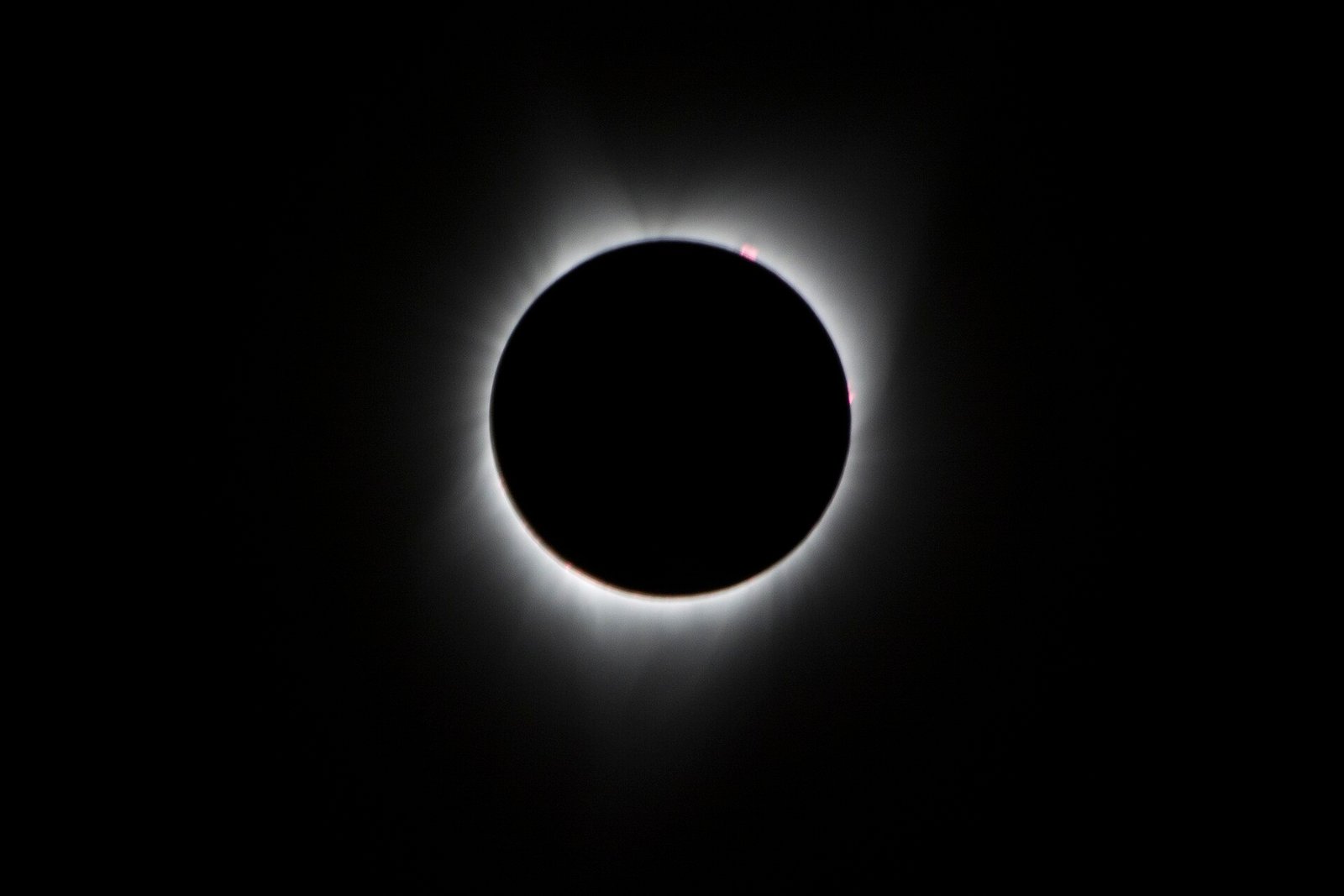
The next two years of eclipses are already written in the sky — and two of them are genuinely spectacular. A total solar eclipse lasting more than six minutes sweeps across Spain and North Africa in August 2027, a “ring of fire” eclipse ends at sunset over Spain in January 2028, and 2028 closes with a total lunar eclipse on New Year’s Eve. Below is the complete calendar through the end of 2028, drawn from NASA’s official eclipse catalogs, with the events that matter most for US and UK readers picked out.
Key points
- The next solar eclipse is the annular (“ring of fire”) eclipse of February 6, 2027, visible from South America and Africa.
- The biggest event of the period is the total solar eclipse of August 2, 2027: totality across southern Spain, Morocco, Algeria, Libya and Egypt lasting up to 6 minutes 23 seconds, a partial eclipse across most of Europe — and a dawn partial in northern Maine.
- The January 26, 2028 annular eclipse brings a late-morning partial eclipse to the eastern United States and a sunset partial to the UK, while the ring itself crosses South America and ends over Spain.
- There is no total lunar eclipse in 2027 at all. The next blood moon is December 31, 2028 — a New Year’s Eve eclipse that rises over the UK already in totality.
- Every date and visibility region below comes from NASA’s GSFC eclipse catalogs (Fred Espenak).
Every eclipse from now to the end of 2028
Solar eclipses happen when the Moon passes between Earth and the Sun; lunar eclipses when Earth passes between the Sun and the Moon. A total solar eclipse shows only along a narrow path, while a lunar eclipse can be seen from the entire night side of Earth. Here is everything coming up, in order — the four 2026 eclipses sit at the top for completeness.
| Date | Eclipse | Type | Where it can be seen |
|---|---|---|---|
| Feb 17, 2026 | Solar | Annular | Already happened — ring path over Antarctica; partial across southern South America and southern Africa |
| Mar 3, 2026 | Lunar | Total | Already happened — the Americas, East Asia, Australia and the Pacific |
| Aug 12, 2026 | Solar | Total | Already happened — totality in the Arctic, Greenland, Iceland and Spain; partial across Europe and northern North America |
| Aug 28, 2026 | Lunar | Partial | Already happened — the Americas, Europe and Africa |
| Feb 6, 2027 | Solar | Annular | Ring across Chile and Argentina; partial across South America, Antarctica and western and southern Africa |
| Feb 20, 2027 | Lunar | Penumbral | The Americas, Europe, Africa and Asia — a deep penumbral eclipse (see below) |
| Jul 18, 2027 | Lunar | Penumbral | East Africa, Asia, Australia and the Pacific — extremely faint (see below) |
| Aug 2, 2027 | Solar | Total | Totality in southern Spain, Morocco, Algeria, Tunisia, Libya, Egypt, Saudi Arabia and Yemen; partial across most of Europe, much of Africa, the Middle East, eastern Canada and northern Maine |
| Aug 17, 2027 | Lunar | Penumbral | The Americas and the Pacific, overnight on Aug 16–17 |
| Jan 12, 2028 | Lunar | Partial | The Americas, Europe and Africa — but only a tiny bite (see below) |
| Jan 26, 2028 | Solar | Annular | Ring across Ecuador, Peru, Brazil and Suriname, ending at sunset over Spain and Portugal; partial across eastern North America, Central and South America, western Europe and northwest Africa |
| Jul 6, 2028 | Lunar | Partial | Europe, Africa, Asia and Australia |
| Jul 22, 2028 | Solar | Total | Totality in Australia and New Zealand; partial across Southeast Asia |
| Dec 31, 2028 | Lunar | Total | Europe, Africa, Asia, Australia and the Pacific — the New Year’s Eve blood moon |
Three honest footnotes. The February 20, 2027 penumbral eclipse is the deepest of its kind in this period: the Moon misses Earth’s dark inner shadow by a whisker, so one side of it shades noticeably darker — subtle, but visible. The July 18, 2027 penumbral eclipse is the opposite: the Moon barely grazes the shadow’s outer edge and the effect is effectively invisible; it is listed only for completeness. And the January 12, 2028 partial eclipse is real but tiny — about 7% of the Moon’s diameter dips into the dark shadow, a bite rather than a show.
The best eclipses for the United States
American skywatchers have a supporting role in this period rather than the headline act — but four dates are worth circling.
January 26, 2028 — a morning partial eclipse for the East. The annular eclipse whose ring crosses South America and Spain sends its partial phase across eastern North America late that morning (greatest eclipse: 15:08 UTC, 10:08 a.m. Eastern); New York and Miami will see the Moon take a modest bite out of the Sun. Eclipse glasses are essential — an annular eclipse has no safe naked-eye moment.
August 2, 2027 — a dawn sliver in the far Northeast. The great eclipse of 2027 clips North America only at the edge: a partial eclipse at dawn in northern Maine and eastern Canada. For most of the United States this is a watch-it-online event — but the closest totality comes to US soil in these two years.
February 20–21, 2027 — the deep penumbral Moon. No filters, no glasses, no travel: on the evening of February 20 in the Americas, the full Moon slides through the edge of Earth’s shadow and darkens noticeably on one side — the most watchable US lunar event of 2027.
August 16–17, 2027 — a second penumbral Moon. Overnight across the Americas, the Moon is shaded again, more gently — a photographer’s event, not a spectacle.
And one to manage expectations on: the December 31, 2028 total lunar eclipse is a European and African show — the Moon is below the horizon for the continental United States while fully eclipsed.
The best eclipses for the UK and Europe
If the United States has a supporting role in 2027–2028, the UK and Europe have the lead. Spain, remarkably, gets a total eclipse in 2026, another in 2027 and an annular eclipse in 2028 — three in a row.
August 2, 2027 — the big one. Totality crosses southern Spain and the Balearic Islands in the late morning, then runs through Morocco, Algeria, Libya and Egypt, where it lasts up to 6 minutes 23 seconds. From the UK this is a deep partial eclipse; from Spain, the event of a generation, a year after the total eclipse that crossed Iceland and Spain in August 2026 — see our coverage of Europe and the Arctic preparing for that rare total eclipse. Book travel early.
January 26, 2028 — a ring at sunset. The annular path ends over southern Portugal and Spain at sunset. Britain is outside the ring but well inside the partial zone: the Sun sinks while still covered — the UK’s last solar eclipse of this calendar.
December 31, 2028 — the New Year’s Eve blood moon. The UK’s standout lunar event: the Moon rises in the east on New Year’s Eve already entering totality, and the whole total phase — about 71 minutes, peaking at 16:53 UTC — plays out low in the early-evening sky. A deep-red Moon rising over New Year’s Eve is as photogenic as astronomy gets; the colour is the same effect behind the changing colours of the Moon in our photo coverage.
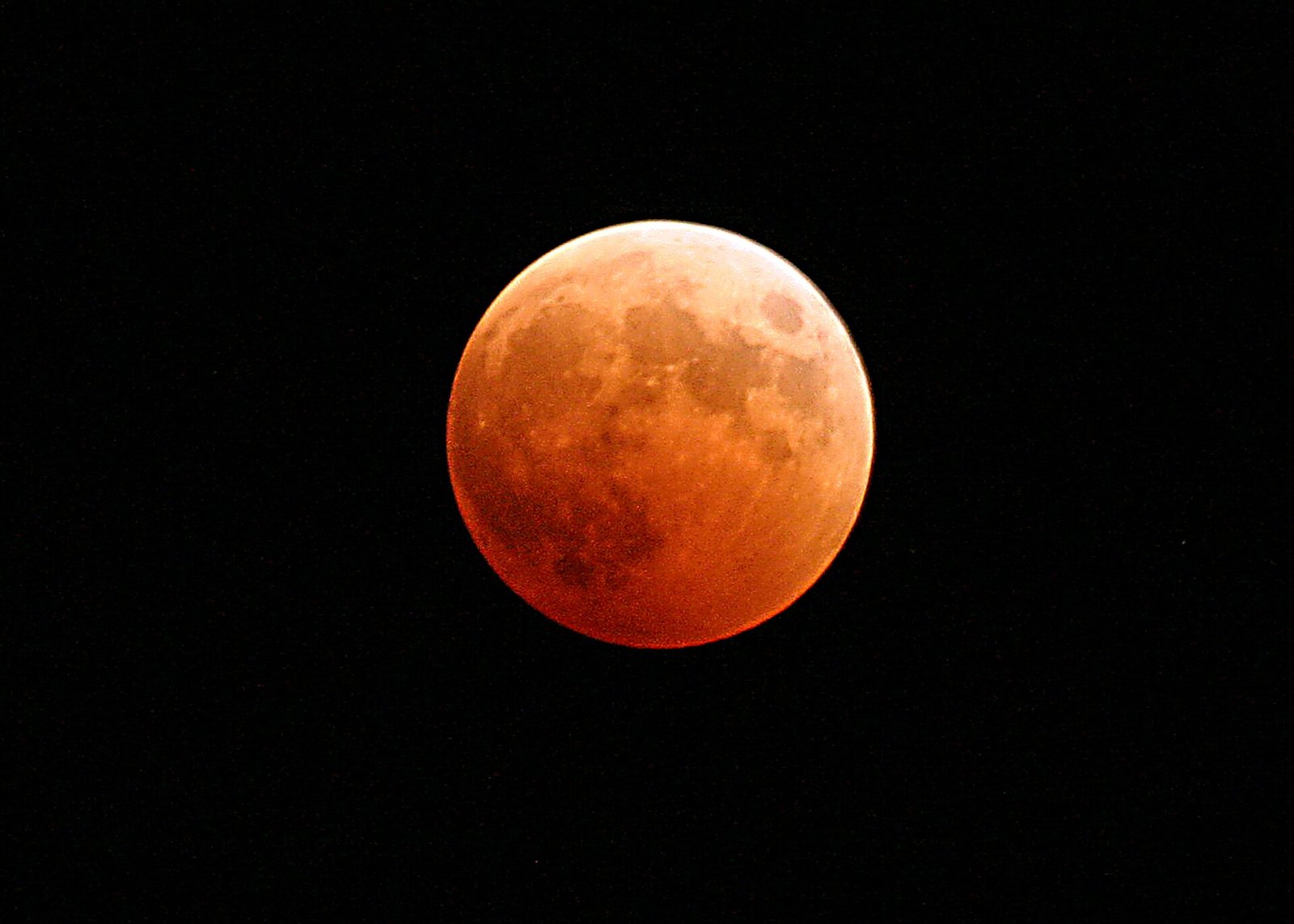
February 20, 2027 — a late-night penumbral. Visible from the UK late on February 20 (greatest eclipse 23:14 UTC); the shaded edge is easy to photograph even if gentle to the eye.
Two entries to be honest about: the January 12, 2028 partial eclipse is visible from the UK in the early hours, but with only about 7% of the Moon in shadow it is a curiosity, not an event; and the July 6, 2028 partial eclipse peaks at 18:20 UTC — daylight in Britain, Moon below the horizon. That one belongs to Africa, Asia and Australia.
How to watch a solar eclipse safely
NASA’s guidance is blunt: except during the brief total phase of a total solar eclipse, it is never safe to look directly at the Sun without specialised eye protection. Looking at the bright Sun through a camera lens, binoculars or a telescope without a proper solar filter over the front of the optics causes severe eye injury instantly.
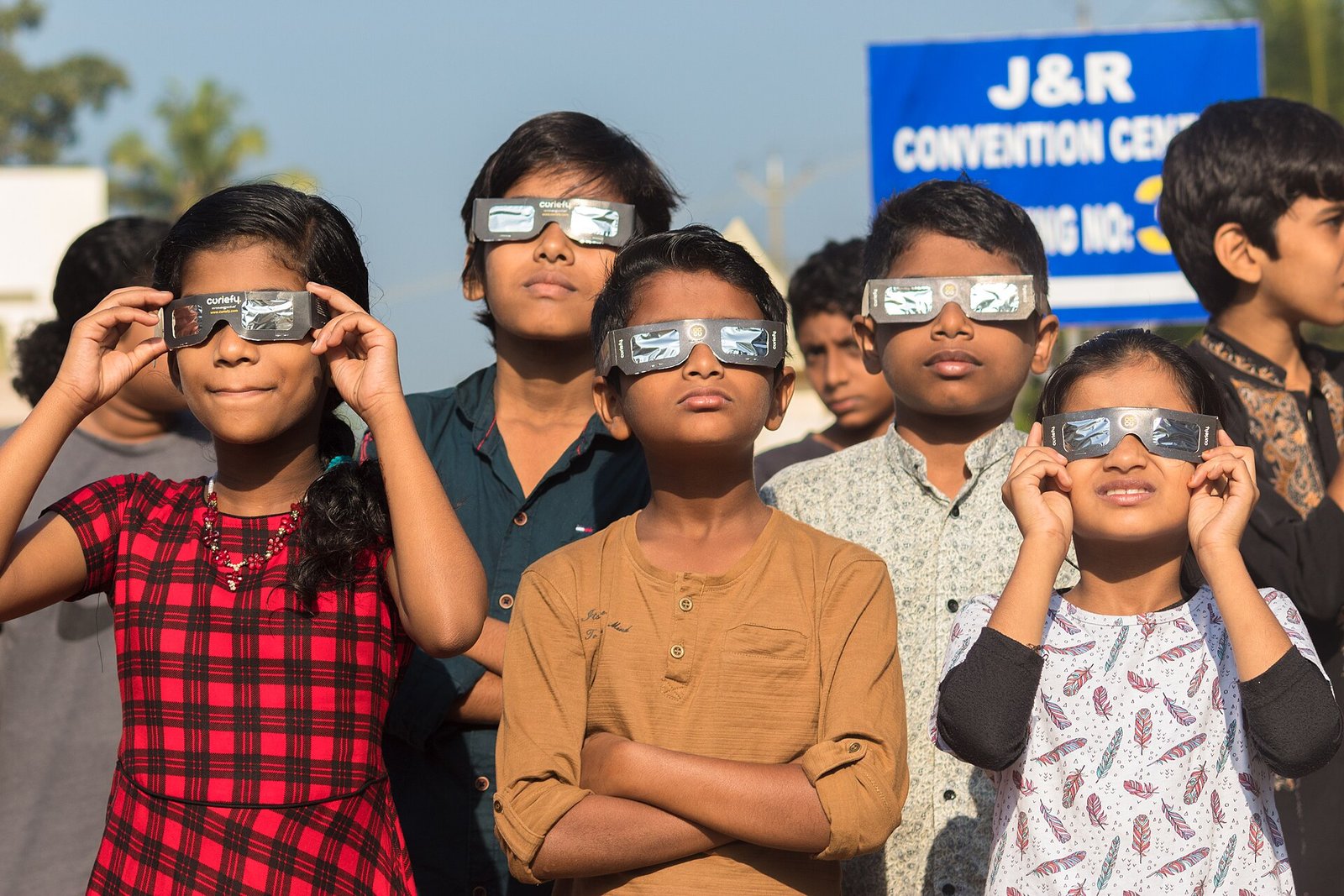
- Use certified eclipse glasses or a handheld solar viewer for every partial and annular eclipse, and for the partial phases around totality. Safe viewers comply with the ISO 12312-2 standard and are thousands of times darker than regular sunglasses — ordinary sunglasses are not safe. (For what not to do, see the skateboarder who rode through the 2026 eclipse shadow — professionals only.)
- Inspect your viewers before use. Torn, scratched or damaged glasses go in the bin; supervise children using solar viewers.
- Never combine glasses with optics. Do not look through a camera, binoculars or telescope while wearing them — concentrated rays burn straight through the filter. Optics need their own filter, secured over the front.
- The one naked-eye moment: during a total solar eclipse, look directly only when the Moon completely covers the Sun’s bright face — totality. The instant any bright Sun reappears, glasses go back on.
- No glasses? Go indirect. A pinhole projector — a hole punched in card, or a box with foil and a paper screen — projects an image of the crescent Sun you can watch with the Sun at your back. Never look through the pinhole.
- Lunar eclipses are different: no eye protection is needed to watch the Moon — just a clear sky, plus sunscreen and a hat for long solar sessions.
Other sky dates to circle
Eclipses are not the only dated shows in the sky. Three meteor showers stand out in the American Meteor Society’s calendar for this period:
- Geminids — peak night December 13–14, 2026. Usually the strongest shower of the year, and one of the few that performs before midnight. In 2026 the Moon is a thin 15%-lit crescent, so conditions are genuinely favourable.
- Quadrantids — peak night January 3–4, 2027. A short, sharp peak predicted near 3:30 UTC on January 4, favouring Europe and the UK; the slim crescent Moon should not interfere. Expect around 25 meteors an hour under dark skies.
- Perseids — peak night August 12–13, 2027. The most popular shower of the year, with normal rural rates of 30–50 an hour — but in 2027 a bright 79%-lit Moon will wash out fainter meteors, so watch after moonset.
Frequently asked questions
When is the next solar eclipse?
The annular eclipse of February 6, 2027 — ring across Chile and Argentina, partial across much of South America, Antarctica and southern Africa. The next one visible from the United States is the partial phase of the August 2, 2027 total eclipse (northern Maine); from the UK, that eclipse’s deep partial phase.
When is the next total solar eclipse?
August 2, 2027. Totality crosses southern Spain, Morocco, Algeria, Tunisia, Libya, Egypt, Saudi Arabia and Yemen, lasting up to 6 minutes 23 seconds — the headline event of this calendar.
When is the next blood moon?
Not until December 31, 2028. There is no total lunar eclipse anywhere on Earth in 2027 — only gentle penumbral ones — so the New Year’s Eve 2028 eclipse is the next time the Moon turns red.
What is the difference between a solar eclipse and a lunar eclipse?
In a solar eclipse the Moon passes between Earth and the Sun; the fully eclipsed region is a narrow path and the event lasts minutes at any one place. In a lunar eclipse Earth’s shadow falls on the Moon; anyone on the night side of Earth can watch, over hours.
Do I need eclipse glasses for a lunar eclipse?
No. A lunar eclipse is safe to watch with the naked eye — the Moon is never brighter than an ordinary full Moon. Eclipse glasses are for the Sun: mandatory for partial and annular eclipses, and for every moment of a total eclipse outside totality.
Why does Spain get so many eclipses in 2026–2028?
Sheer orbital luck: totality crossed Iceland and Spain in August 2026, returns to southern Spain in August 2027, and the annular path ends over Spain and Portugal in January 2028. Eclipse paths drift across the globe over time — for these three years, the drift keeps landing on Iberia.
Sources
- NASA Goddard Space Flight Center (Fred Espenak) — Solar Eclipses: 2021–2030: https://eclipse.gsfc.nasa.gov/SEdecade/SEdecade2021.html
- NASA Goddard Space Flight Center (Fred Espenak) — Lunar Eclipses: 2021–2030: https://eclipse.gsfc.nasa.gov/LEdecade/LEdecade2021.html
- NASA Science — Future Eclipses: https://science.nasa.gov/eclipses/future-eclipses/
- NASA Science — Eclipse Viewing Safety: https://science.nasa.gov/eclipses/safety/
- American Meteor Society — 2026/2027 Meteor Shower Calendar: https://www.amsmeteors.org/calendar/
1 comment on “Eclipse Calendar 2027–2028: Every Solar and Lunar Eclipse, and Where to See Them”