

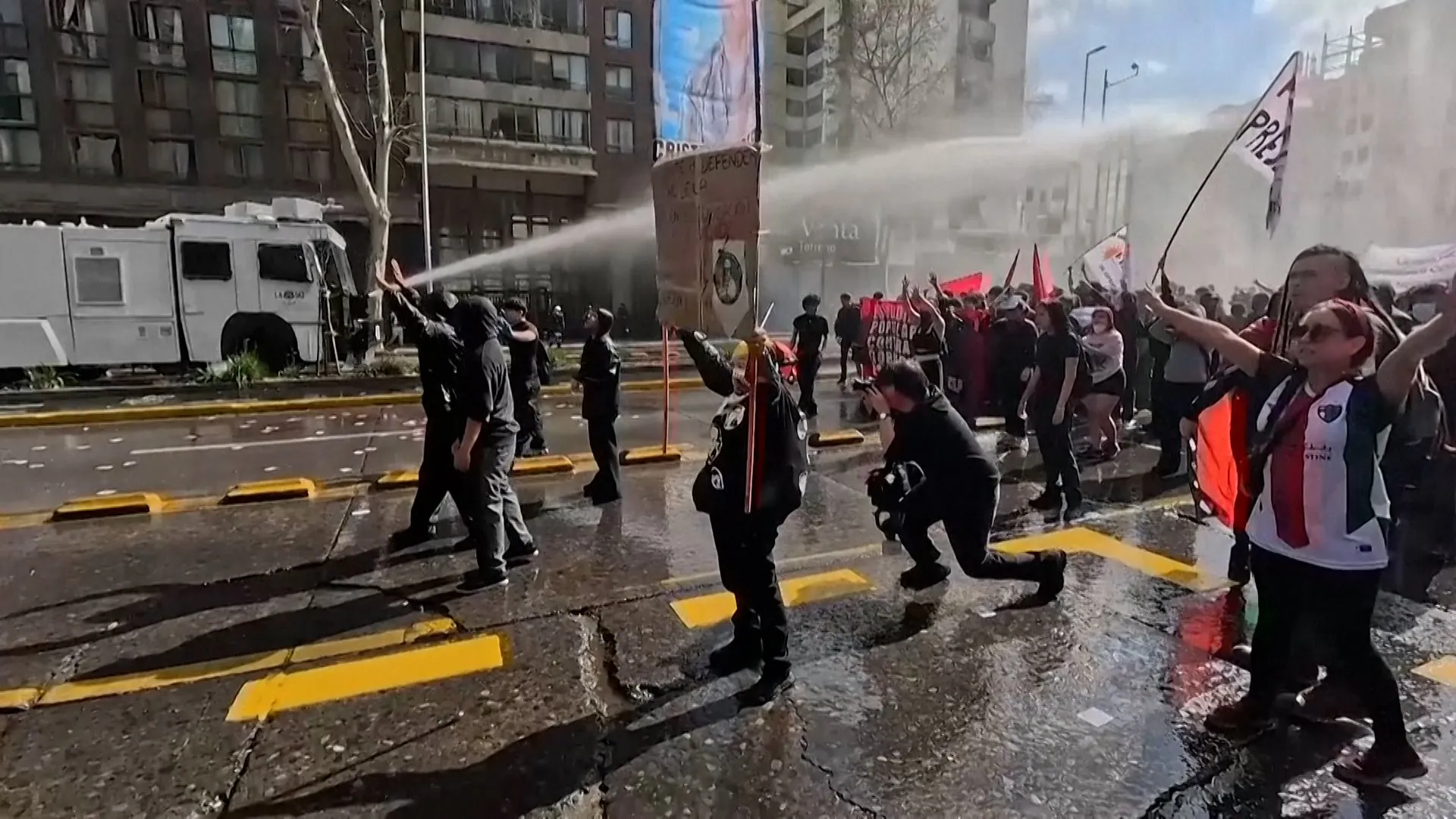
Violent demonstrations broke out in Santiago as protesters clashed with police during a contentious international forum featuring Argentine President Javier Milei.
Tensions reached a boiling point in Santiago as security forces and demonstrators engaged in direct confrontations outside a high-profile political gathering. The unrest centered around the Madrid Forum, an international assembly known for its conservative and far-right ideological leanings. As participants arrived for the summit, the atmosphere on the streets turned volatile, with police utilizing crowd-control measures to manage the surging crowds gathered in opposition to the event.
The arrival of several high-profile international figures, including Argentina’s President Javier Milei, served as a catalyst for the heightened activity. Protesters, representing a wide array of social and political movements, gathered to express their strong disapproval of the forum’s agenda. The resulting skirmishes between law enforcement and activists highlighted the deep-seated political polarization currently gripping the nation, as the presence of international leaders transformed a local event into a flashpoint for broader societal grievances.
The Madrid Forum has consistently acted as a polarizing entity within the Latin American political landscape. gies, the organization often finds itself at odds with progressive movements and civil society groups that advocate for different social policies. The summit in Santiago was intended to foster dialogue among like-minded conservative leaders, yet it instead drew significant scrutiny and organized resistance from those who perceive the forum's rhetoric as harmful to democratic stability.
Critics of the gathering argue that the assembly promotes exclusionary politics and undermines the progress made maintain that such platforms are essential for countering what they describe as the influence of radical left-wing policies in South America. This fundamental disagreement over the direction of the region's political future was physically manifest in the streets surrounding the conference venue, where opposing viewpoints collided in a display of public discontent.
In response to the demonstrations, local authorities deployed significant police resources to secure the perimeter of the forum. The deployment included specialized units tasked with maintaining order, which led to intense interactions between officers and those protesting the summit. The use of traditional crowd-control tactics during the event underscored the challenge faced ssity of maintaining public safety during high-stakes diplomatic and political gatherings.
As the situation developed, the presence of security personnel became a focal point for the protesters, who viewed the heavy police presence as an intimidation tactic rather than a security necessity. This dynamic exacerbated the friction, leading to reports of property damage and minor injuries as the crowd attempted to breach designated security zones. The events of the day have prompted a wider discussion regarding the management of political protests in Santiago and the implications of hosting controversial international summits in an already volatile political climate.
The incident outside the Madrid Forum serves as a stark reminder of the fragile state of public discourse in Chile. The country continues to navigate a complex period of political transformation, where the influence of external political actors is increasingly scrutinized not merely observers of international political trends but are actively engaged in shaping the ideological boundaries of their nation.
Moving forward, the government faces the difficult task of ensuring that international visitors can convene without endangering public order, while also addressing the underlying causes of the public’s frustration. Whether through further policy debates or increased social dialogue, the events in Santiago underscore the reality that ideological clashes are no longer confined to legislative halls but are actively spilling into the public square, demanding attention from both national leaders and the international community at large.