

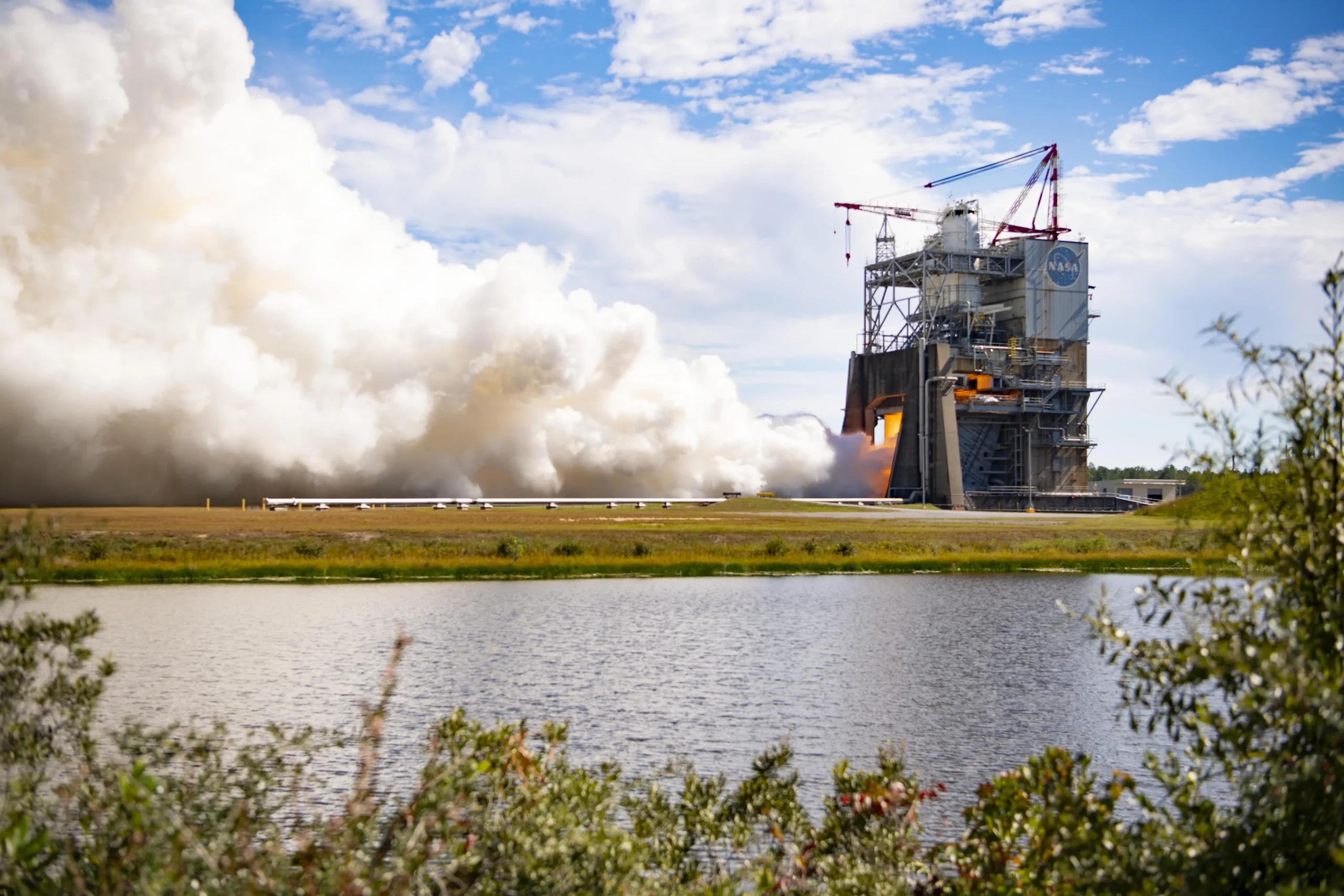
NASA recently tested an RS-25 rocket engine at the Stennis Space Center to gather data for future Artemis missions.
Teams at the NASA Stennis Space Center recently held a major engine test. The site sits near Bay St. Louis, Mississippi. Workers tested the RS-25 engine number 10001 on October 21, 2026.
Also, the hot fire test lasted for about eight and a half minutes. This equals 500 seconds of total run time. The engine fired at a 111 percent power level.
Next, experts matched this duration to an actual SLS rocket launch. The Space Launch System requires this exact timing to reach space. Engineers carefully monitor every second of these ground tests.
Furthermore, four of these powerful engines help launch the SLS rocket. They generate up to 2 million pounds of combined thrust. This massive power helps the Artemis missions leave Earth.
As a result, NASA must ensure every engine is ready for flight. Officials prove the flightworthiness of all RS-25 hardware at Stennis. Safety remains the top priority for every space mission.
However, this specific engine will not travel to space. It serves as a developmental tool for researchers. The team uses it to gather important performance data.
Then, NASA works closely with its prime engine contractor, L3Harris Technologies. Both groups study the information from the hot fire test. This partnership helps improve future engine designs.
Finally, these tests increase overall reliability for the program. Better data leads to safer flights for astronauts. NASA continues to refine its technology at the Mississippi facility.