

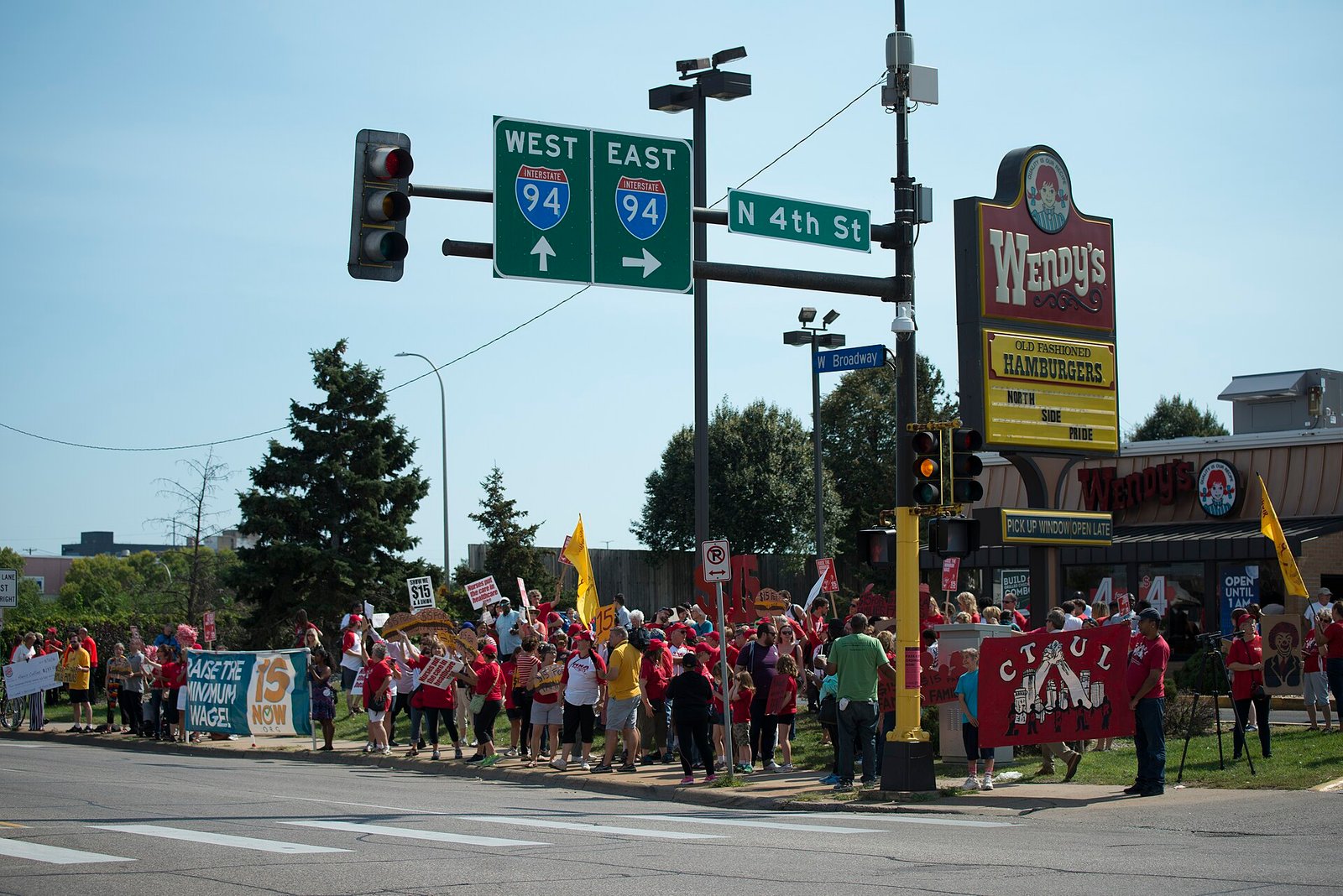
The lowest legal pay for an hour’s work in America depends entirely on which side of a state line the job sits. In Washington state it is $17.13. In Washington, DC it is $18.40. In 20 states it is still the federal floor — $7.25, a figure set in 2009 that has now been frozen longer than any minimum in the law’s history. This page carries the complete, current table from the US Department of Labor, the handful of states about to move again on January 1, 2027, and — for our UK readers — Britain’s National Living Wage alongside.
Key points
- The federal minimum wage is $7.25 an hour, unchanged since July 24, 2009. It applies everywhere, but 30 states and DC set higher rates that override it.
- Highest in 2026: Washington, DC $18.40; Washington state $17.13; New York (downstate) $17.00; Connecticut $16.94; California $16.90.
- Five states have no state minimum wage law at all (Alabama, Louisiana, Mississippi, South Carolina, Tennessee) — the federal $7.25 governs there.
- January 1, 2027 brings the annual round of rises: Michigan is scheduled to reach $15.00, and the inflation-indexed states adjust by formula.
- In the UK, the National Living Wage (21+) is £12.71 in 2026 and rises to £13.21 on April 1, 2027.
- Where federal, state and city rates differ, the worker gets the highest of them — and many cities set rates above their state.
The full table: minimum wage by state, 2026
Rates below are the basic minimum wage per hour published by the US Department of Labor (Wage and Hour Division) for 2026 — the rate that applies to most covered workers in each state. Footnotes flag the states where the headline figure needs context.
| State | 2026 rate | State | 2026 rate | State | 2026 rate |
|---|---|---|---|---|---|
| Alabama | $7.25 † | Kentucky | $7.25 | North Dakota | $7.25 |
| Alaska | $14.00 | Louisiana | $7.25 † | Ohio | $11.00 |
| Arizona | $15.15 | Maine | $15.10 | Oklahoma | $7.25 |
| Arkansas | $11.00 | Maryland | $15.00 | Oregon | $15.55 ‡ |
| California | $16.90 | Massachusetts | $15.00 | Pennsylvania | $7.25 |
| Colorado | $15.16 | Michigan | $13.73 § | Rhode Island | $16.00 |
| Connecticut | $16.94 | Minnesota | $11.41 | South Carolina | $7.25 † |
| Delaware | $15.00 | Mississippi | $7.25 † | South Dakota | $11.85 |
| District of Columbia | $18.40 | Missouri | $15.00 | Tennessee | $7.25 † |
| Florida | $14.00 | Montana | $10.85 | Texas | $7.25 |
| Georgia | $7.25 * | Nebraska | $15.00 | Utah | $7.25 |
| Hawaii | $16.00 | Nevada | $12.00 | Vermont | $14.42 |
| Idaho | $7.25 | New Hampshire | $7.25 | Virginia | $12.77 |
| Illinois | $15.00 | New Jersey | $15.92 | Washington | $17.13 |
| Indiana | $7.25 | New Mexico | $12.00 | West Virginia | $8.75 |
| Iowa | $7.25 | New York | $17.00 / $16.00 ‡ | Wisconsin | $7.25 |
| Kansas | $7.25 | North Carolina | $7.25 | Wyoming | $7.25 * |
† No state minimum wage law — employers covered by the federal Fair Labor Standards Act must pay the federal $7.25.
* Paper rate below the federal floor — Georgia and Wyoming list $5.15 in state law, but FLSA-covered employers must pay $7.25, which is the rate that applies to most workers.
‡ Regional rates — New York: $17.00 in New York City, Nassau, Suffolk and Westchester counties; $16.00 in the rest of the state. Oregon: $15.55 standard; $16.80 in the Portland metro area; $14.55 in non-urban counties.
§ Scheduled rise — Michigan’s rate is set by law to increase to $15.00 on January 1, 2027.
Three reading notes the Department of Labor itself attaches to this table: some states set different rates for very small employers (Ohio and Montana among them); some set lower training or youth rates; and many cities and counties set minimums above their state’s — those local rates are not in the state table, but they are the law where the job is, and the worker always receives the highest applicable rate.
The federal floor: $7.25 since 2009
The federal minimum wage has been $7.25 an hour since July 24, 2009 — the final step of a three-stage increase legislated in 2007. It has not moved since: more than seventeen years, the longest freeze since a federal minimum was first set in 1938. Adjusted for inflation, $7.25 today buys what roughly five dollars bought when it was set — the arithmetic behind recurring proposals to raise it sharply, including the $25 federal minimum wage proposal whose economic impact we analysed. The same inflation is what the Federal Reserve has spent 2026 fighting — our explainer on how the Federal Reserve affects interest rates traces what that has meant for household budgets from the other direction.
Until Congress acts, the federal rate functions as a floor for the 20 states that have not set anything higher — and as an irrelevance in the 30 states and DC that have, where the state rate governs. That split is the single most important fact in American pay policy: for most US workers, the minimum wage is now effectively written in state capitals, not in Washington.
Tipped wages, briefly
Waiters, bartenders and other tipped workers sit under a second, lower federal figure: the tipped cash wage of $2.13 an hour. An employer may pay that directly provided the worker’s tips carry them to at least the full minimum wage — and if they do not, the employer must make up the difference. States vary widely here: some require the full state minimum before tips, others track the federal system. Because the state-by-state tipped table changes as often as the main one, check your state labor office’s current figure before relying on it — the rule that never changes is the top-up: nobody may legally end the hour below the applicable minimum.
What changes on January 1, 2027
Minimum-wage news arrives on a fixed calendar, and the next date is close:
- Michigan rises to $15.00 on January 1, 2027, completing its legislated climb from $13.73 (per the Department of Labor).
- The indexed states adjust. Around twenty states tie their rate to inflation by formula — California, Washington, New Jersey, Maine, Minnesota, Vermont, Virginia, South Dakota and Alaska among them — and their 2027 figures are announced by state labor agencies through the autumn. This page’s table is re-verified against the Department of Labor on January 1, 2027.
- DC adjusts on July 1 each year by formula; Oregon’s regional rates also reset July 1.
- Contrast the mechanism with benefits: Social Security payments rise automatically with inflation every year — the 2.8% COLA for 2026 in our Social Security payment schedule and COLA guide — while the federal wage floor, uniquely, has no index at all. It moves only when Congress votes.
For UK readers: the National Living Wage
Britain runs the opposite system — one national rate structure, set centrally, updated every April 1 — with the top rate carrying a different name. Figures from GOV.UK:
| Rate | April 2026 | From April 1, 2027 |
|---|---|---|
| National Living Wage (21 and over) | £12.71 | £13.21 |
| National Minimum Wage (18–20) | £10.85 | £11.27 |
| Under 18 | £8.00 | £8.31 |
| Apprentice | £8.00 | £8.31 |
No US-style state variation exists — the rate is the same in London as in Leeds (employers may pay the voluntary, higher “real Living Wage,” but it is not law). For transatlantic context only — exchange rates move, and the comparison is illustrative, not a cost-of-living verdict — the UK’s £13.21 for 2027 sits well above the US federal floor and below the highest US state rates.
Frequently asked questions
What is the federal minimum wage in 2026?
$7.25 an hour, where it has stood since July 24, 2009. It is the default in the 20 states without a higher state rate — and any worker whose state or city sets more gets the higher amount.
Which state has the highest minimum wage?
Washington state, at $17.13 an hour in 2026. The only higher figure in the country is Washington, DC at $18.40 — a district, not a state. New York’s downstate rate is $17.00, Connecticut $16.94 and California $16.90.
Which states still pay $7.25?
Twenty states sit at the federal floor in practice: thirteen set $7.25 directly (including Texas, Pennsylvania, Indiana, North Carolina and Wisconsin); two — Georgia and Wyoming — list $5.15 in state law, which the federal rate overrides for covered employers; and five — Alabama, Louisiana, Mississippi, South Carolina and Tennessee — have no state minimum wage law at all, so the federal rate governs.
When does the minimum wage go up in 2027?
Most rises land on January 1, 2027 — Michigan’s scheduled step to $15.00 and the inflation adjustments in the indexed states. Washington, DC and Oregon reset on July 1. The UK’s rates rise on April 1, 2027 (National Living Wage to £13.21).
What is the tipped minimum wage?
Federally, employers may pay tipped workers $2.13 an hour in direct wages, provided tips bring the total to at least $7.25 — and the employer must top up any shortfall. Several states require the full state minimum before tips; check your state labor office for its current tipped rate.
Can a city set a higher minimum wage than its state?
Yes, in most states — and many do. The Department of Labor’s state table does not list local rates, but they are binding law where the work is done, and the employee receives the highest of the federal, state and local rates that apply.
Sources
- US Department of Labor, Wage and Hour Division — State Minimum Wage Laws (the complete 2026 state-by-state table reproduced here): https://www.dol.gov/agencies/whd/minimum-wage/state
- GOV.UK — National Minimum Wage and National Living Wage rates (April 2026 rates and the published April 2027 rates): https://www.gov.uk/national-minimum-wage-rates