
October marks a busy time for global politics, space science, and North American trade. Major updates define the path for the weeks ahead.
October brings significant changes across the globe. From space exploration to international trade, major events are unfolding. New scientific projects and political races remain at the top of the news. Each of these stories carries weight for our future.
Meanwhile, stargazers can look to the night sky for unique sights. The autumn months offer clear views of deep-space wonders. These celestial events remind us of the vast universe beyond our planet. Space agencies continue to push the boundaries of what we can learn.
Why this matters
These developments show how connected our world is today. Political choices in Brazil affect South American stability and global markets. Similarly, trade deals between neighbors determine the price of goods for average families. Space research helps us solve medical problems that affect millions on Earth.
Decisions made now will shape the coming years. Leaders must balance national interests with international cooperation. Science also plays a key role in our daily lives. Keeping track of these stories helps us understand the path ahead.
Global Politics and Trade Updates
Brazil faces a tense presidential race this October. President Luiz Inacio Lula da Silva leads Senator Flavio Bolsonaro by two points. A Datafolha poll shows this narrow gap in a simulated run-off. Recent surveys suggest the race remains a technical tie.
After that, Canada and the United States work to finalize a trade deal. Negotiators met in Washington to beat a strict midnight deadline. They hope to avoid new tariffs on steel, aluminum, and cars. Some Canadian leaders worry the deal hurts their local industries.
Also, the trade discussions include access to dairy markets. Canada may allow more American dairy products into its stores. In return, they want lower taxes on their own exported goods. Negotiators continue to talk as the clock ticks down.
Space Exploration and Research
NASA and SpaceX prepare for a new resupply mission. A Falcon 9 rocket will carry cargo to the space station. This mission delivers vital solar arrays for station power. Scientists also hope to study new experiments during this trip.
Next, the flight will transport equipment for medical research. Astronauts will test hardware to make artificial retinas in space. Other experiments include 3D heart cell models to improve drug testing. These studies could help treat serious diseases on Earth.
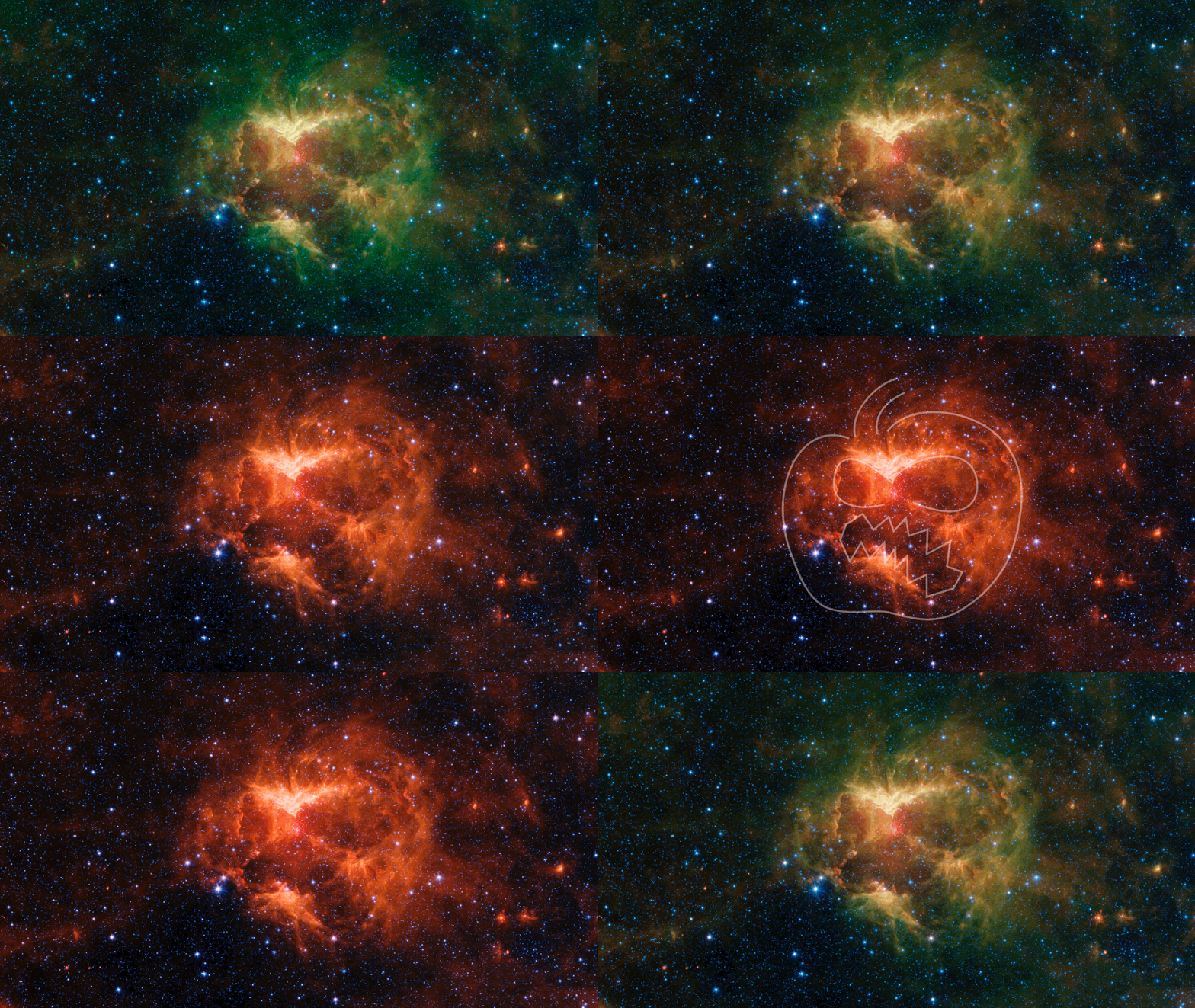
Finally, skywatchers can observe the "Demon Star" known as Algol. It appears to blink because of its binary star system. Experts also suggest looking for the Witch Head Nebula. These sights provide a great way to enjoy the night sky.
How we got here
- August 2026: Canada and the U.S. began intense trade negotiations in Washington.
- September 17, 2026: NASA opened media accreditation for the 35th SpaceX resupply mission.
- September 22-23, 2026: Datafolha conducted a survey of 2,002 people regarding the Brazilian election.
- September 25, 2026: Poll results showed a tight race between Lula and Flavio Bolsonaro.
What happens next
The Brazilian election results will likely remain uncertain until the final vote. Run-off rules may decide the winner if no one reaches 50 percent. Analysts watch to see if these margins change in the coming weeks.
Meanwhile, the U.S. and Canada must decide on their trade framework soon. Failure to agree could lead to new taxes on imported goods. Both sides face pressure to protect their own economies from harm.
Finally, the SpaceX launch will provide a boost to orbital research. Successful power upgrades will keep the space station running safely. Researchers will analyze the new data from these experiments for years to come.