

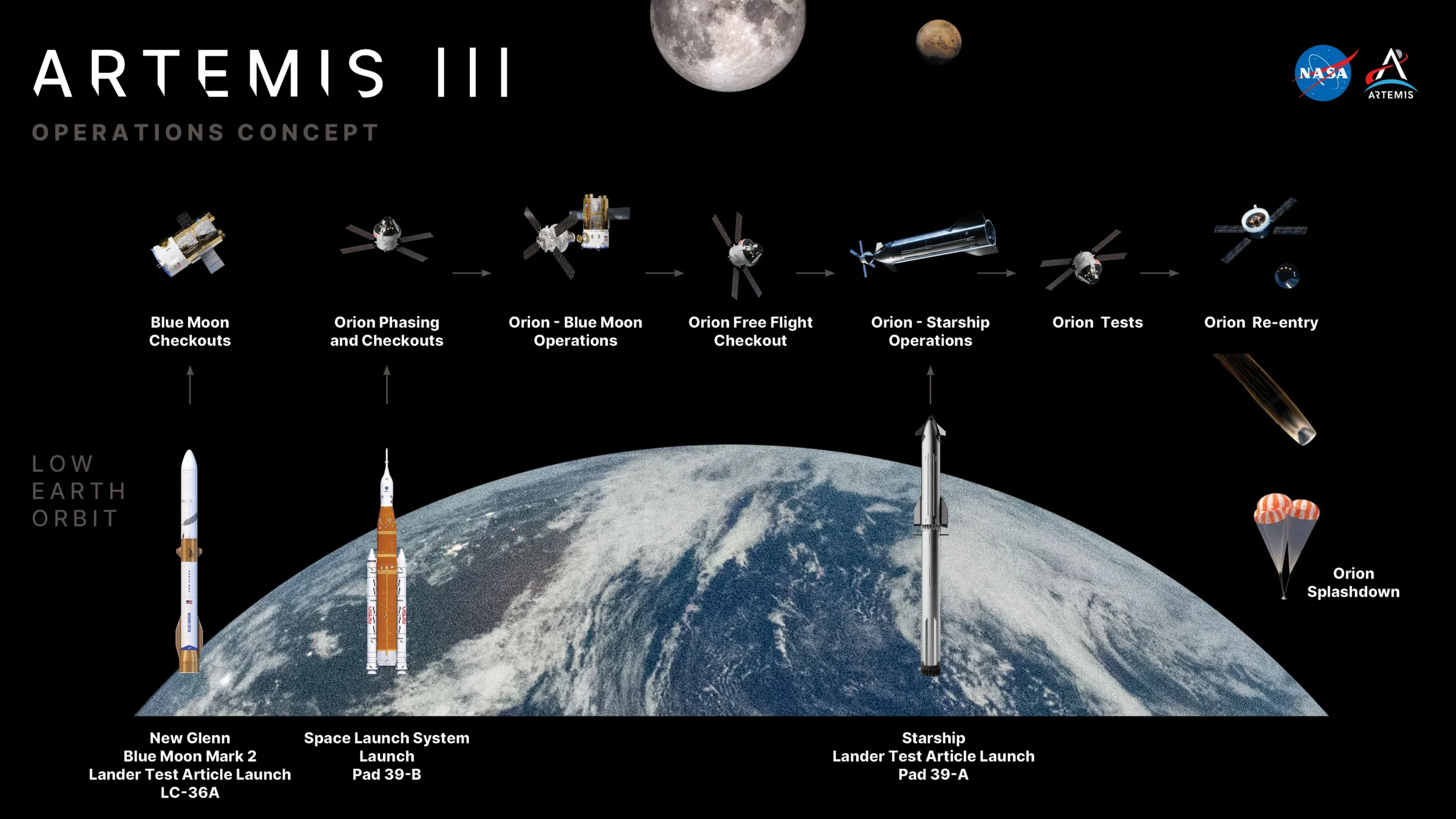
NASA will launch the Artemis III mission in 2027 to test lunar landers and docking procedures in orbit before returning astronauts to the Moon.
NASA plans an ambitious test mission in 2027 called Artemis III. This flight helps prepare the agency for future lunar landings. Four astronauts will travel into orbit aboard the Orion spacecraft. They will practice key procedures for landing near the Moon's South Pole.
Next, the crew will test hardware from partners like Blue Origin and SpaceX. This mission involves three different rockets and three separate spacecraft. NASA has never attempted this complex operation before. It helps lower risks for future moon missions.
First, Blue Origin will launch a test version of its lander. It will wait in orbit for the Orion spacecraft. Orion will then perform a series of maneuvers. The crew will dock with the lander to evaluate its systems.
Also, astronauts will enter the lander to check the cabin environment. They will test life-support systems and controls firsthand. This provides vital data on how the hardware performs in space. It ensures everything works correctly before actual lunar landings.
Then, the mission shifts to a test with SpaceX. The crew will dock with a Starship test vehicle. They will study how the two spacecraft interact together. This phase focuses on software and communication performance between the ships.
Meanwhile, the mission generates data for many future exploration goals. Astronauts will test their survival suits and new sensors. They will also conduct science experiments in orbit. These studies help prepare for long trips to deep space.
After that, the crew will practice health assessments without direct contact with mission control. This skill is vital for future missions far from Earth. Researchers will also test ways to handle lunar samples safely. All these tasks build experience for upcoming moon flights.
Finally, the crew will prepare for their journey home. Orion will splash down in the Pacific Ocean near California. NASA and the Navy will recover the team. This mission successfully proves the technologies needed for humanity’s return to the Moon.