

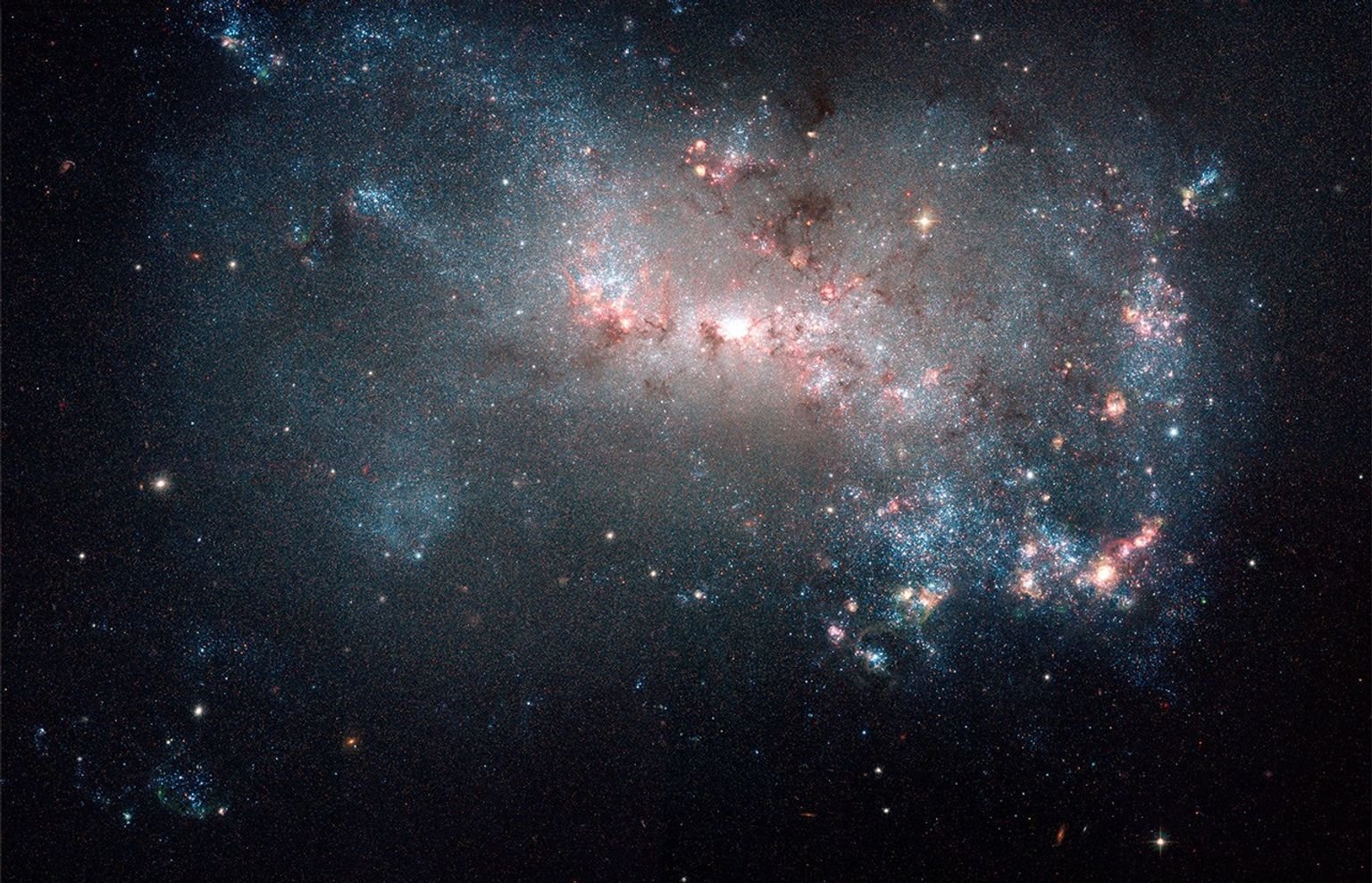
NASA researchers used the Hubble Space Telescope to find that small dwarf galaxies are missing significant amounts of oxygen.
NASA’s Hubble Space Telescope recently solved a cosmic mystery. Researchers studied 37 nearby dwarf galaxies. They discovered that much of the expected oxygen is missing.
Scientists know stars create oxygen inside these galaxies. Therefore, the oxygen must have been present at some point. It was likely pushed out of the galaxies.
Next, experts believe massive stars and supernova explosions provide the power. These events create strong galactic winds. The winds blow material into the space between galaxies.
Also, these winds remove more oxygen than current models predict. Dwarf galaxies only keep a small amount of the oxygen their stars produce. This finding changes how experts view galaxy evolution.
Meanwhile, the GLOW project team tracked oxygen to understand its distribution. They looked at stars, gas, and the space between galaxies. They chose oxygen because it is easy to detect and measure.
As a result, oxygen acts as a reliable indicator for chemical elements. It helps astronomers learn how galaxies enrich the intergalactic medium. This space exists between different galaxies in the universe.
Then, the researchers used archival data from Hubble. They also used information from the retired Spitzer Space Telescope. Ground-based telescopes provided extra data for the study.
Still, the team specifically selected these 37 dwarf galaxies. They wanted to see how these small systems expel heavy elements. These galaxies are close enough for Hubble to see individual stars.
Finally, the team plans to study even smaller galaxies soon. They will use the Roman Space Telescope to find faint systems. Future research will continue to reveal how galaxies grow and change over time.