
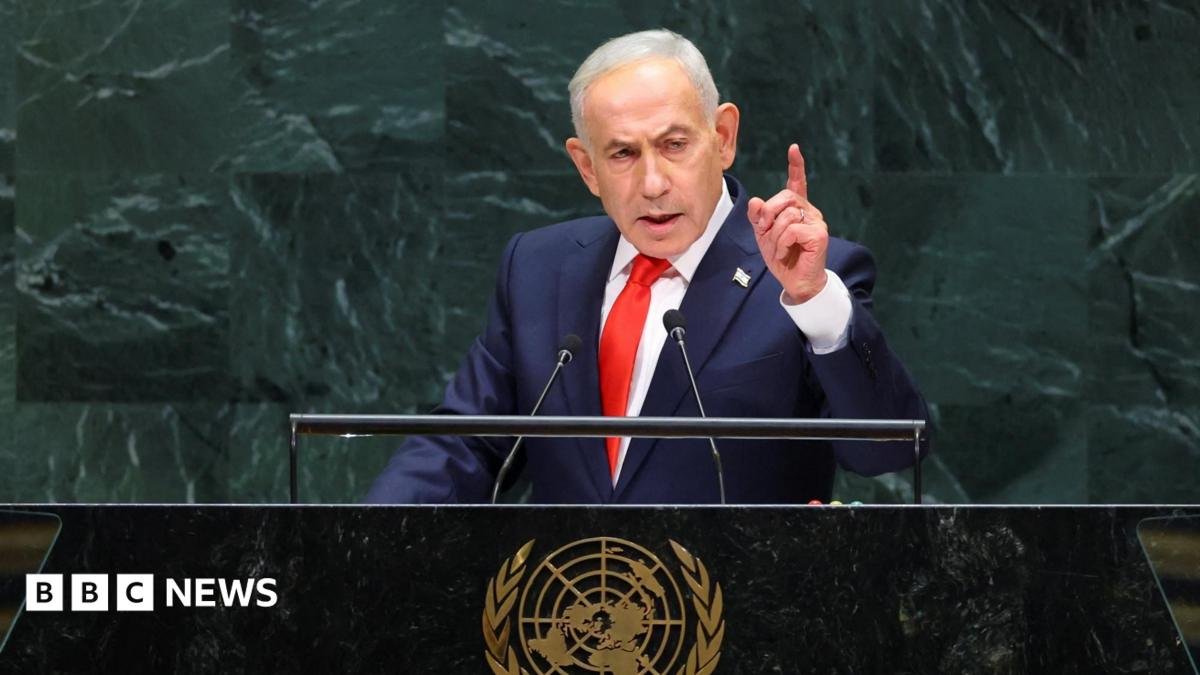
Israeli leaders face walkouts at the UN while a soccer player earns a red card for a controversial goal celebration in Austria.
Global tensions are rising as political and sports arenas become protest sites. Leaders struggle to maintain order while public anger grows worldwide. These events highlight a deep divide in how nations view current conflicts. The actions in New York and Austria show how protests now transcend traditional boundaries.
Meanwhile, the use of international platforms for political messaging puts pressure on neutral organizations. Groups like the UN and UEFA face difficult choices about their roles. The friction between national identity and global policy creates a fragile environment for diplomacy. Leaders must now navigate a landscape where every public move sparks a reaction.
Israeli Prime Minister Benjamin Netanyahu addressed the UN General Assembly this week. Many delegates walked out of the room as he began his speech. Netanyahu called those who left "moral cowards" during his address. He defended Israel’s military actions in Gaza and Iran despite the protests.
Also, the Prime Minister rejected claims of genocide. He criticized leaders from Britain and France for their remarks on colonialism. He labeled Turkish President Recep Tayyip Erdogan a tyrant during his talk. Furthermore, he claimed that residents of New York feel unsafe under the current city leadership.
After that, Palestinian President Mahmoud Abbas spoke to the UN through a video message. He could not travel to the US due to visa issues. He argued that Israeli policies threaten the existence of the Palestinian people. Abbas stated that the current war in Gaza harms the possibility of a two-state solution.
Tensions spilled over into the world of professional soccer during a match in Austria. Israeli player Sayed Abu Farchi scored a goal for his team. He then celebrated d a red card to the player.
Next, the match officials removed him from the game. UEFA rules state that players must not act in provocative ways. The Israeli team eventually lost the match to Austria eld.
Finally, the Republic of Ireland’s football association expressed concerns about playing against Israel. They requested to avoid matches with the Israeli team. UEFA denied this request, keeping the scheduled matches in place. These teams are set to play again on neutral ground soon.
Observers expect continued protests at international events throughout the year. Diplomatic relations between Israel and Turkey likely face more strain after recent remarks. Governments will watch these interactions closely to assess risks to stability.