Israeli authorities are increasingly utilizing AI surveillance tools to track and accelerate the demolition of Palestinian structures throughout the West Bank.
The integration of artificial intelligence into military and administrative operations has moved beyond theoretical debate, becoming a tangible force in the occupied West Bank. Reports indicate that Israeli authorities are increasingly utilizing sophisticated AI-driven tools to monitor Palestinian land, identify building modifications, and accelerate the process of forced displacement. This shift represents a transition from manual, ground-based monitoring to a high-speed, automated system capable of scanning vast geographic areas with unprecedented efficiency.
At the center of this technological deployment is a platform known as ImiSight. Originally developed and deployed to survey and target structures within Bedouin communities inside Israel—many of which exist in villages not recognized ntifying structural changes through aerial imagery, the system provides a digital justification for demolition orders in areas where obtaining legal building permits remains notoriously difficult for the Palestinian population.
The administrative framework for this operation was bolstered in April 2025 with the establishment of an Israel Land Authority enforcement unit specifically mandated to operate within the West Bank. Rights organizations have characterized this development as a significant step toward formal annexation, noting that it brings civilian governmental apparatuses directly into the occupied territory. rveillance model that treats the entire region as an environment for automated oversight.
The speed and accuracy of these demolitions are supported mputing. Unlike traditional systems that require large-scale data centers to process images, modern satellites equipped with powerful processors can now analyze data while still in orbit. This allows for the immediate identification of changes in the landscape, providing near-real-time intelligence to authorities on the ground.
This satellite-based edge computing functions as an automated intelligence node. Once the system detects an unauthorized structure or a modification to an existing one, it transmits the data directly to the enforcement agencies. This process minimizes the time between a building’s completion and the issuance of a demolition notice. Experts argue that this technological leap has turned the entire occupied territory into a laboratory for surveillance, where algorithms dictate the pace of enforcement actions.
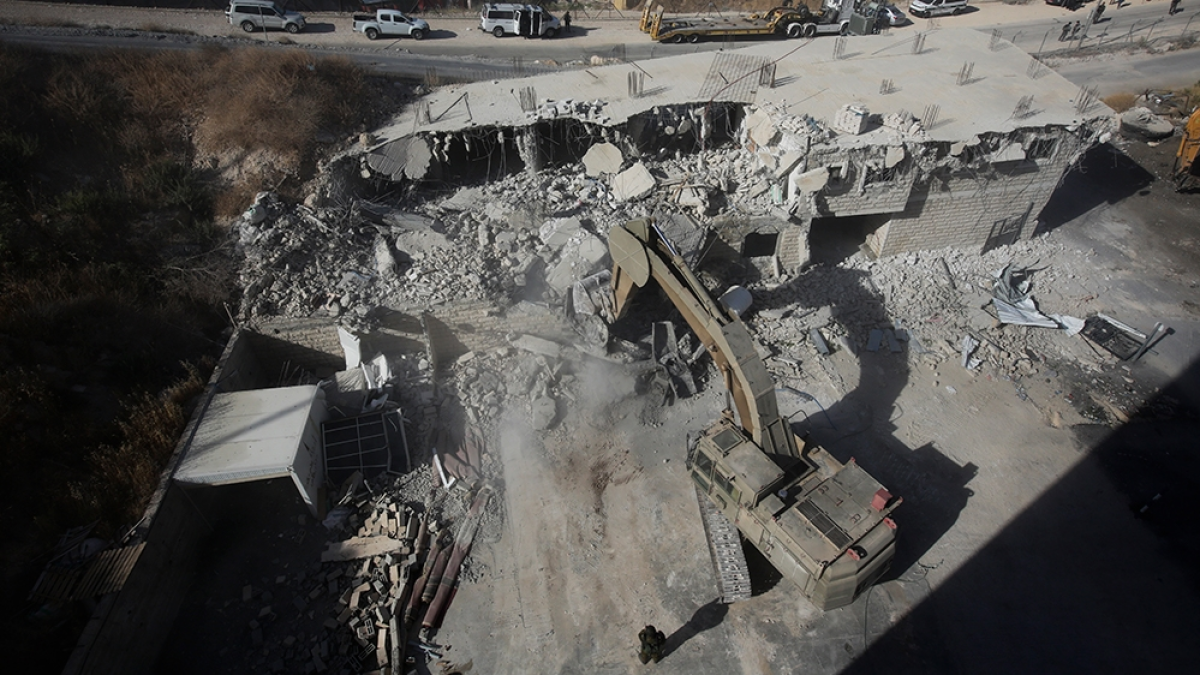
The impact of this automation on the ground has been profound. Between 2023 and 2025, data compiled Area C and East Jerusalem compared to previous years. The efficiency provided and execute destruction on a scale that would be logistically impossible using traditional, manual survey methods alone.
The move toward fully automated enforcement raises severe ethical concerns regarding the removal of human judgment from life-altering decisions. Critics warn that when algorithms are tasked with determining the fate of homes and communities, the responsibility for those actions becomes obscured. m enables decision-makers to deflect accountability, shifting the burden onto the technology itself.
This automated approach occurs alongside a broader trend of settlement expansion, creating a stark disparity in how land is managed. While AI tools are used to expedite the demolition of Palestinian structures, the state simultaneously provides funding and infrastructure to illegal settler outposts. Observers note that the system functions as an engine for segregation, where one group faces rapid, technology-driven displacement while another enjoys retroactive legalization and state-sponsored services.
Furthermore, the use of the West Bank as a testing ground for these surveillance technologies offers a secondary benefit to the defense industry. nt, the developers are able to refine their algorithms and demonstrate their efficacy. This creates a market-ready product that can be sold globally, effectively turning the occupation into a showroom for advanced surveillance technology.