

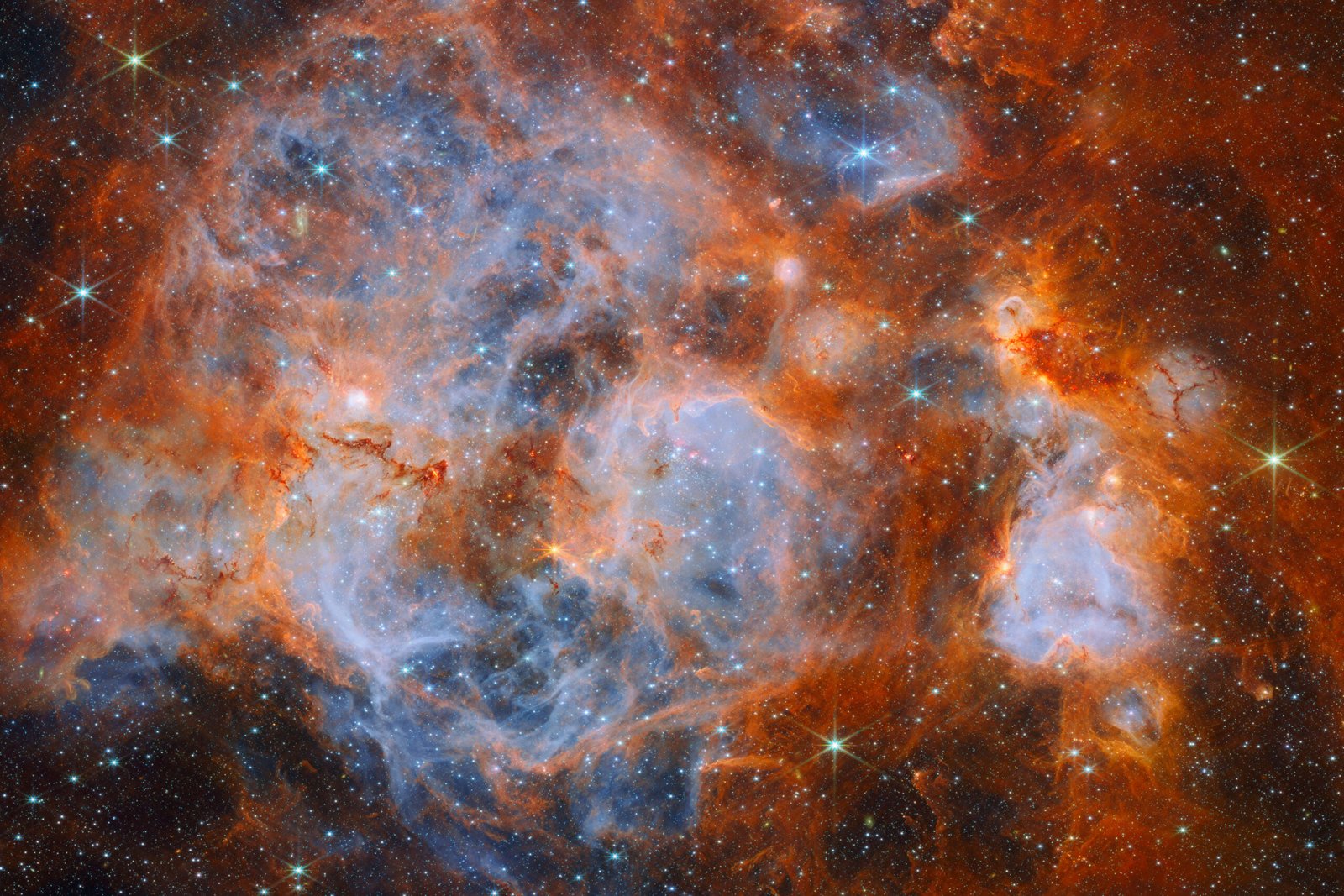
The James Webb Space Telescope captured a detailed view of a star nursery called N159. This region offers clues about how stars formed in the early universe.
The James Webb Space Telescope recently captured a stunning new view of a star nursery. Experts released this image on October 22, 2026. It shows a busy area filled with thick clouds of gas.
Scientists call this specific region N159. It sits 161,000 light-years away from our own planet. The area exists within the Large Magellanic Cloud.
Also, this cloud acts as a satellite galaxy for the Milky Way. Researchers find the location very exciting to study. It offers a unique look at how stars begin their lives.
Next, the region contains a smaller amount of heavy elements compared to our galaxy. Astronomers call this low metallicity. It means the area lacks many elements heavier than helium and hydrogen.
Because of this, the nursery behaves differently than regions inside the Milky Way. Experts believe this environment mimics the early universe. It provides a clear window into ancient space history.
Meanwhile, the new data helps scientists learn about star formation. They study how gravity pulls gas together in these conditions. This helps them understand the birth of many celestial bodies.
After that, the team analyzed the dense clumps shown in the photos. These pockets of gas serve as the building blocks for new stars. The telescope captures these details with great precision.
Finally, the mission continues to provide valuable insights for space science. International groups like NASA, ESA, and CSA worked together on this project. Their findings help us map the complex evolution of galaxies.