

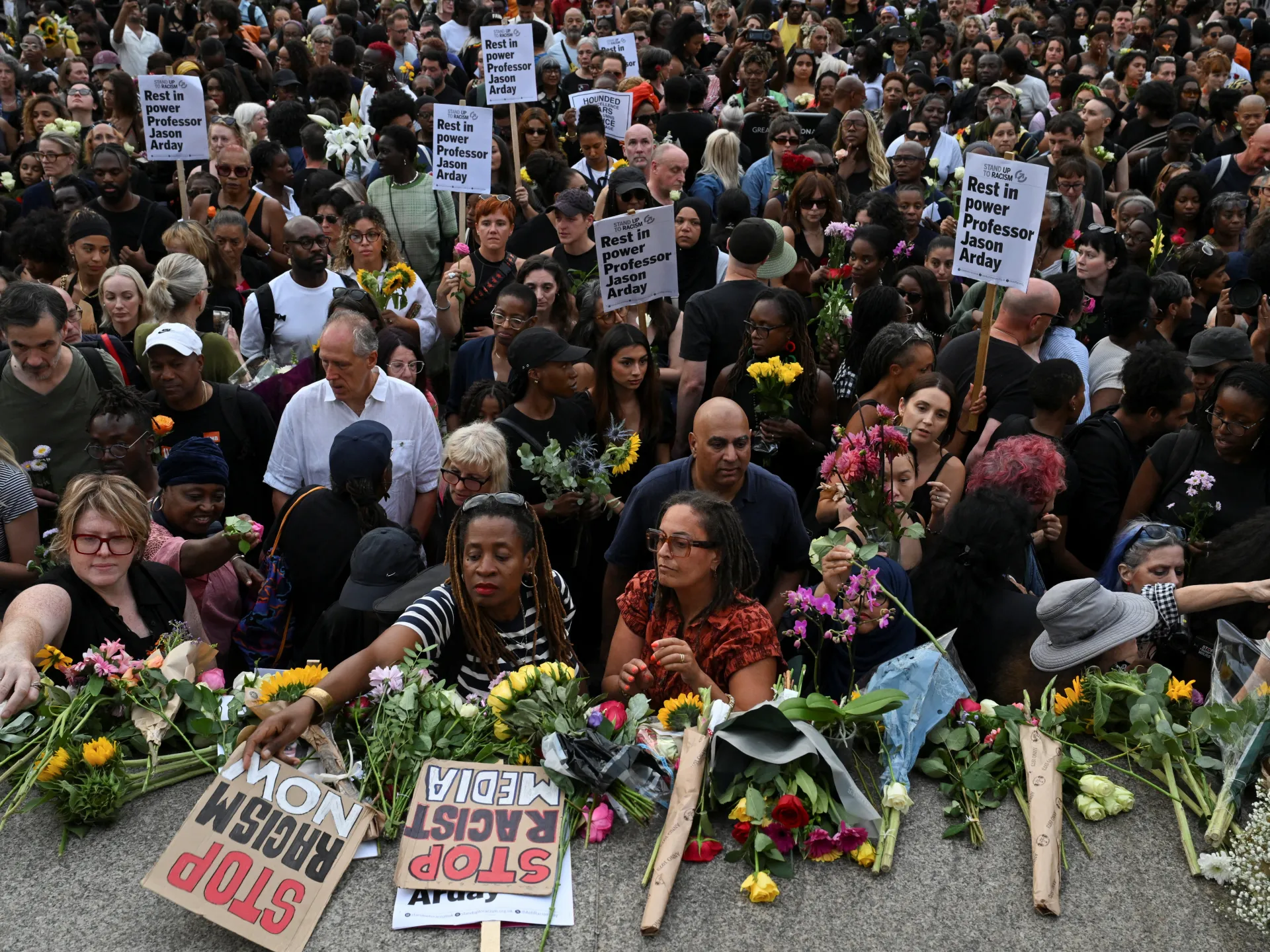
Thousands gathered in London for a vigil honoring the late Professor Jason Arday, with many participants pointing to the role of the media in his tragic death.
Tens of thousands of mourners gathered in London’s Trafalgar Square to honor the memory of Jason Arday, the esteemed academic and former Cambridge University professor. Dressed in black and carrying flowers, the crowd assembled for a vigil to pay their respects to the 41-year-old, who was widely recognized as the youngest Black professor in the history of Cambridge. The atmosphere was somber, marked passing.
Many participants held signs criticizing the role of the media, with slogans explicitly blaming racist narratives for Arday’s death. The vigil served as both a memorial and a platform for those who felt that the intense public scrutiny Arday faced was fundamentally unjust. Attendees expressed deep concern over the way the academic’s personal and professional life had been dissected London.
The tragedy followed weeks of intense media attention centered on allegations that Arday had plagiarized portions of his 2015 doctoral thesis and embellished details regarding his personal biography. Despite the fact that Liverpool John Moores University, which awarded his doctorate, had cleared him of plagiarism claims, the narrative continued to circulate. Arday, who was diagnosed with autism as a child, had consistently denied the accusations brought against him.
Following his resignation from his post at Cambridge on August 5, Arday cited the relentless nature of the accusations as having a profound impact on his personal well-being and his family. The scale of the media coverage was staggering, with reports indicating that nearly 250 articles were published about the academic in the 22 days preceding his death. This intense focus led many to describe the situation as a “racist feeding frenzy,” a term echoed
The intensity of the coverage has sparked a broader debate regarding how the media treats individuals of color in positions of power. A petition currently circulating calls for a public inquiry into the conduct of the press, arguing that Arday’s death was the foreseeable result of sustained harassment. Supporters of the inquiry point to a perceived double standard, contrasting the treatment of Arday with other white academics who faced similar or more serious allegations but received significantly less public and media scrutiny.
Prominent figures, including politicians and artists, attended the vigil to express their support and highlight the systemic issues at play. Speakers emphasized that the campaign against Arday was not merely a matter of reporting facts, but a destructive process that targeted a vulnerable individual. The discourse has shifted toward questioning the accountability of journalists and media outlets that engage in what critics describe as the hounding of minority professionals.
The family of the late professor expressed their gratitude for the outpouring of solidarity but noted that the public cruelty he was subjected to had become an unbearable burden. In a statement, they described Arday as a gentle and selfless individual who dedicated himself to uplifting others. The family’s message underscored a desire for a society that values all human beings equally, echoing the academic’s own long-standing personal philosophy.
As the conversation continues, advocates for media reform are pushing for better monitoring and regulation of journalistic practices to ensure that personal integrity and mental health are not sacrificed for the sake of sensational headlines. The vigil in London stands as a poignant reminder of the human cost of public discourse and the urgent need for a more equitable approach to how the media portrays individuals from diverse backgrounds.