

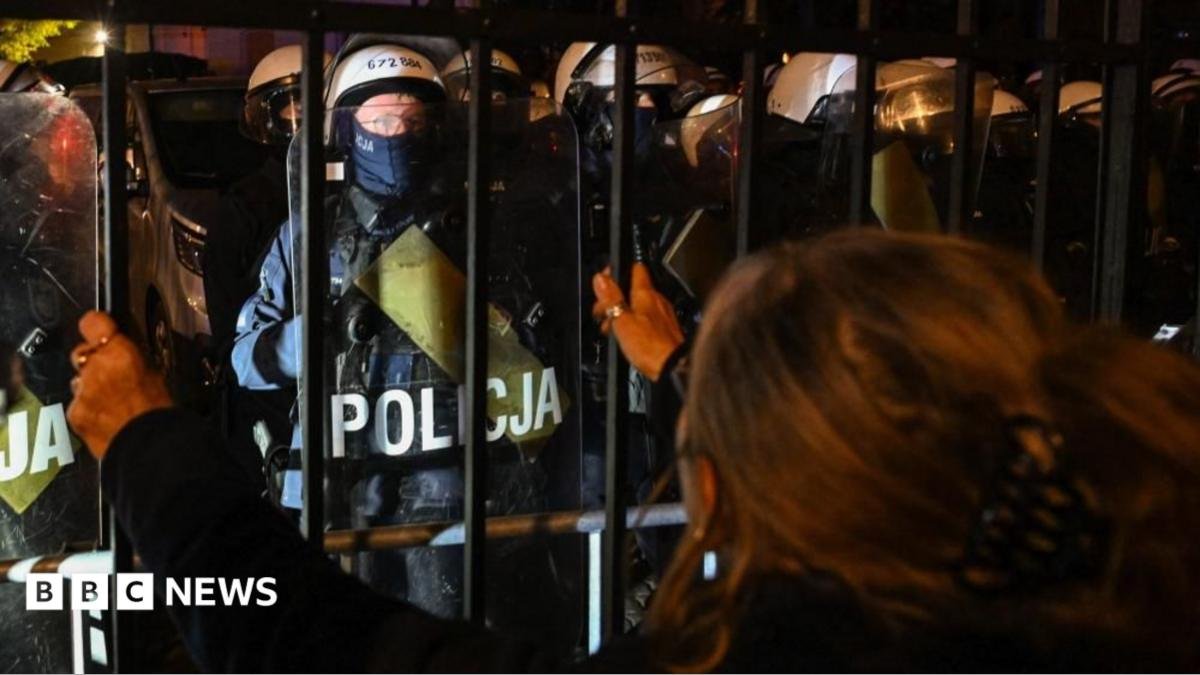
Polish police guarded the Constitutional Tribunal after the government suspended its top two justices and pursued criminal charges.
A major political conflict erupted in Poland regarding the Constitutional Tribunal. The government recently suspended the court's two highest-ranking justices. Officials also initiated plans to bring criminal charges against these leaders.
Next, Justice Minister Waldemar Żurek requested the removal of immunity for President Bogdan Święczkowski and Vice-President Bartłomiej Sochański. This step allows prosecutors to pursue formal charges against both men.
Meanwhile, opposition politicians from the Law and Justice party organized a demonstration. They gathered outside the court building in Warsaw to protest the government's aggressive actions.
As a result, authorities deployed riot police to the scene. The officers blocked protesters from entering the court facility to maintain order.
However, the Constitutional Tribunal maintains that the suspension is illegal. Officials stated on social media that the two men remain the legitimate leaders. They described the government's recent maneuvers as a coup d'etat.
Prime Minister Donald Tusk defended the decision to intervene. He claims his administration must restore the rule of law. Tusk argues that the previous government created a period of lawlessness that requires bold action.
Also, the ongoing dispute traces back to 2015. At that time, the Law and Justice party gained control of parliament. They quickly appointed new judges to ensure they held the majority within the court.
Then, European courts intervened in the matter. They ruled that Poland had improperly elected several judges. These international bodies declared the tribunal was no longer an independent or impartial institution.
Later, Tusk promised to fix the judiciary after taking office in 2023. He faced significant challenges from the president, who blocked his reform efforts. President Karol Nawrocki even turned his plane around to return to Warsaw during this crisis.
Finally, legal experts remain divided on the outcome. Some critics believe the government's move lacks a solid legal basis. They warn that these actions could damage the rule of law for many years.