

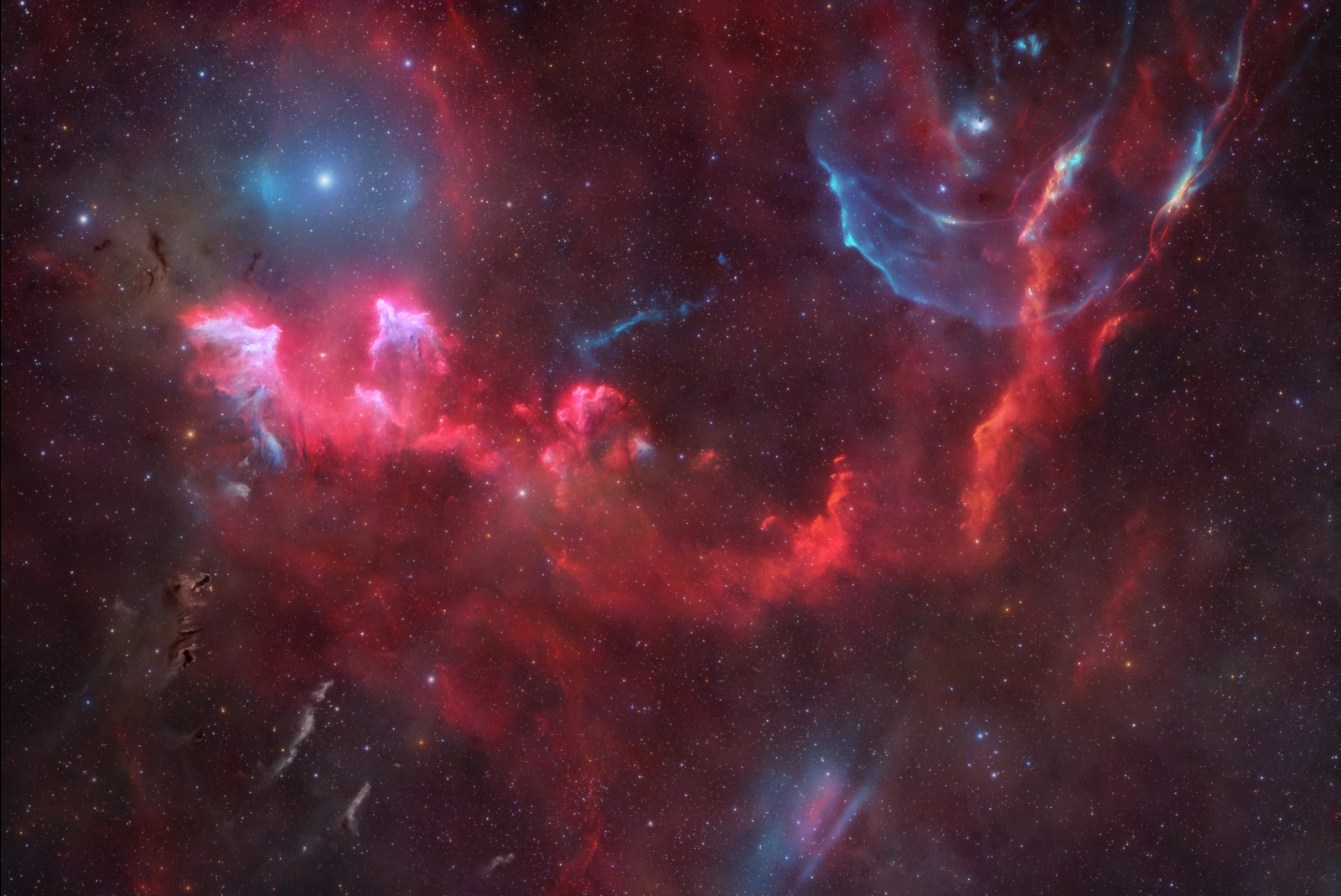
Astronomers discovered three new faint nebulas in the Cassiopeia constellation after 100 hours of observation.
Astronomers recently captured a stunning image of three faint nebulas in the Cassiopeia constellation. They used a special oxygen filter for the project. The team spent 100 hours of observation time to see these hidden structures.
Also, the region already contains famous clouds known as the Ghosts of Cassiopeia. These are named IC 59 and IC 63. They sit near the bright star system called Gamma Cassiopeia.
Next, the intense light from the star system affects these gases. The hydrogen gas glows with a bright red color. Meanwhile, the dust within the clouds reflects and scatters blue-white starlight.
However, the new image reveals three additional objects that look like blue phantoms. Scientists identified these as ionized oxygen. This discovery surprised the research team.
Then, astronomers began to study the cause of this ionization. The Gamma Cassiopeia system moves quickly through space. It acts much like the front of a boat cutting through water.
As a result, the star system piles up gas and dust as it travels. Researchers believe Object 3 represents a shock wave of compressed, heated oxygen. This explains its unique glowing appearance.
Still, other parts of the image remain a mystery. Object 1 might be a planetary nebula. This would require the discovery of a central white dwarf star.
Finally, experts continue to investigate the origins of these cosmic apparitions. The universe holds many secrets for scientists to solve. New technology helps reveal these hidden wonders in deep space.