

NASA is using Hubble’s gravitational lens images to prepare for the upcoming Nancy Grace Roman Space Telescope mission.
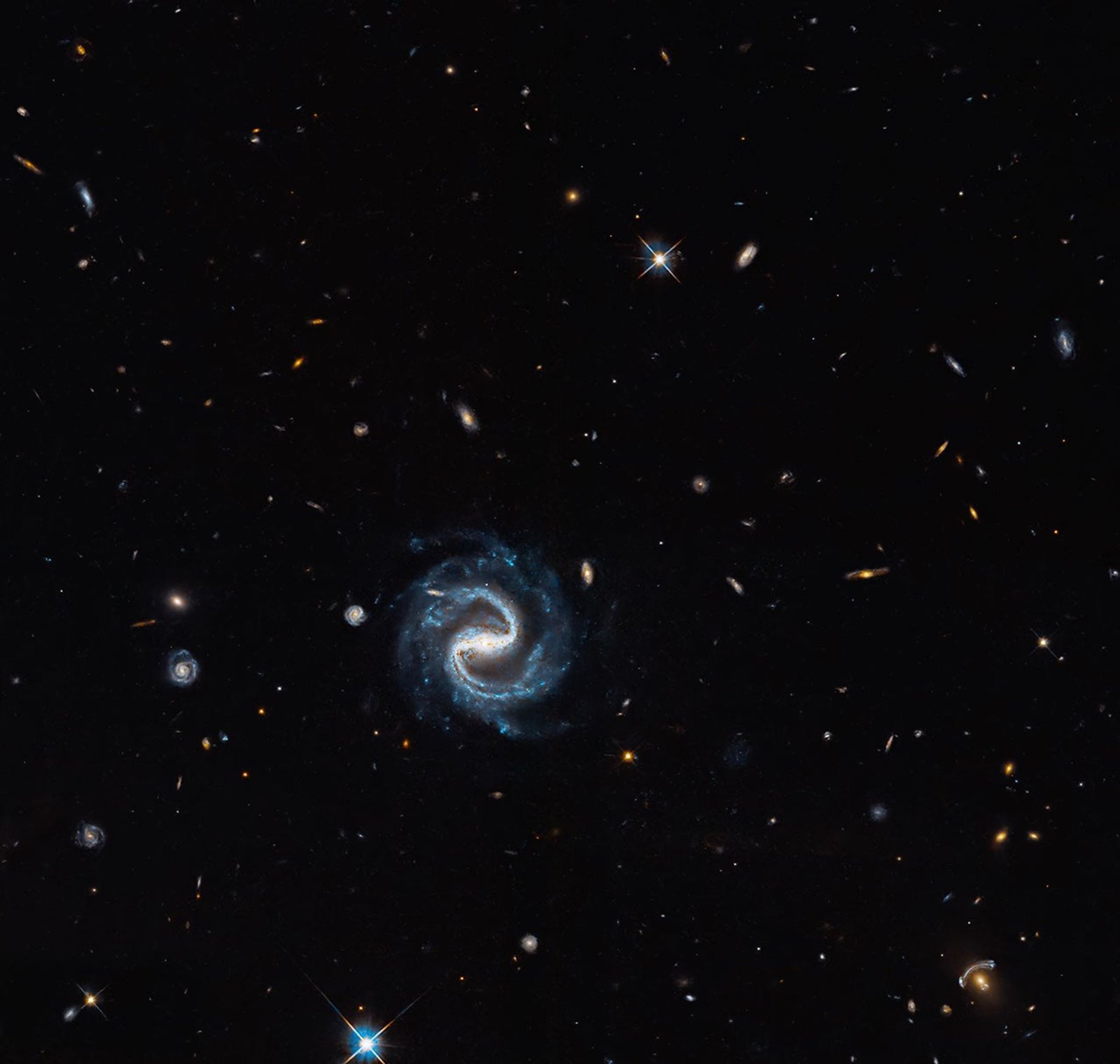
NASA’s Hubble Space Telescope recently captured a stunning image of a distant galaxy. This galaxy sits behind a foreground object that bends its light. This effect is known as gravitational lensing.
Also, this observation helps scientists prepare for the new Nancy Grace Roman Space Telescope. Gravitational lensing happens when a massive object warps the fabric of space. It acts like a giant magnifying glass in the cosmos.
Then, light from a background galaxy curves around a closer foreground galaxy. The foreground galaxy in this image sits 4.5 billion light-years away. The background galaxy is twice as far away at eight billion light-years.
Next, the background galaxy appears as two distinct arcs. Researchers call this specific shape an arc-counterarc pair. These patterns help scientists measure the mass of the foreground galaxy.
Furthermore, mass dictates how much the light bends. By studying these distortions, experts can learn about dark matter. This invisible substance makes up most of the mass in our universe.
Meanwhile, the image shows a large barred spiral galaxy. It looks very similar to our own Milky Way galaxy. A smaller spiral nearby might be a satellite, much like those orbiting our home galaxy.
After that, scientists will use Hubble and Roman together. Hubble provides sharp, high-resolution images of individual objects. Roman offers a much wider field of view for panoramic surveys.
Also, Hubble observes mostly visible and ultraviolet light. Roman focuses primarily on infrared wavelengths. These two telescopes will create a complete map of the cosmos.
Finally, astronomers are building computer models based on Hubble’s data. These models will help analyze the larger images from the Roman mission. Hubble will also follow up on any interesting objects Roman finds.