
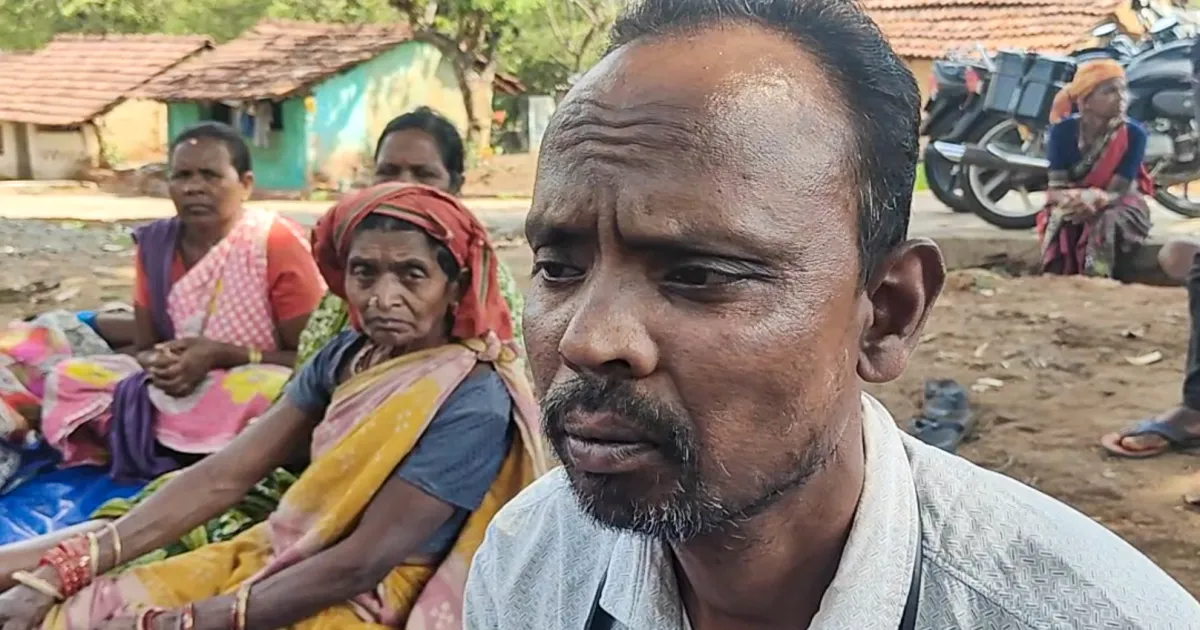
Forged signatures and thumbprints – even of dead and fictitious people – allegedly used to obtain land for bauxite mine.
Koraput, India – Raghunath Khara was shocked to look at his thumb impression on a piece of paper that declared he had consented to a government proposal to mine his village’s pristine forest land for bauxite.
He says he never gave that thumb impression.
“I always sign in English. It was someone else’s thumb,” alleged Khara, a shopkeeper in Balda village in the tribal-dominated Koraput district of Odisha state in eastern India.
Khara is among hundreds of people from Indigenous tribes in Balda and neighbouring Bannur village who have lost their lands to the new bauxite mine. It is being developed by Kalinga Alumina Limited, a subsidiary of Adani Enterprises Limited, a conglomerate owned by Gautam Adani, India’s second richest businessman and close to Prime Minister Narendra Modi.
The $24m project will consume a large chunk of the tabletop Balda Hill – home to forests, grasslands and caves that are considered sacred by at least 10 tribal villages surrounding it.
To push the project, the purported signatures and thumb impressions of nearly 600 tribals were allegedly collected during village council meetings in Balda and Bannur held on October 9 last year. Bannur is 5km from Balda.
Khara says he never attended the meeting at Balda and was instead protesting against the proposed mine with his wife, sister and other villagers about 100 metres from the village council office.
“It [thumb impression] was fake. We didn’t attend the village meeting at all. We were all busy protesting outside,” he told Al Jazeera.
India’s constitution recognises the rights of Indigenous communities over their traditional lands. Forest laws and laws granting autonomy to tribal areas dictate that village council resolutions are mandatory for any diversion of such lands for other purposes.
A resolution passed in a village council meeting is valid only if 50 percent of all the adults in the village consent to it in writing. Government documents claim all the 580 adults – 360 in Balda and 227 in Bannur – agreed to give up their land for the Adani mine. But the elected village heads in both villages denied any signatures were collected and called the two meetings “invalid”.
Even photographs taken by villagers at both council meetings show a combined attendance of about 100 people – nearly 40 in Balda and 68 in Bannur – far below the minimum 50 percent quorum required to pass a valid resolution.
Moreover, the villagers allege that most signatures on the resolution documents are fake, forged or impersonated.
They also claim the documents contain signatures of fictitious persons and even the names of people who died years ago. Some even said their signatures from a previous, unrelated village council meeting were fraudulently pasted onto the bauxite mine document.
Al Jazeera emailed the Adani group and its communications chief on August 18 seeking responses to the accusations of forgery and fraud. Then we followed up with a second request for comments on September 25, but did not receive any response. Al Jazeera also sought responses from Manoj Satyawan Mahajan, the district magistrate — the most senior bureaucrat in Koraput – to the concerns raised by villagers but did not receive a response. Rohit Varma, the superintendent of police for Koraput district, also did not respond to Al Jazeera’s queries.
‘They took the paper away from me’
Many of those who attended the meetings said they were opposed to the mining project.
“We were told that if mining was allowed, the village would get roads, jobs, drainage and water connections and a school built,” said Madhav Kuntili, a farmer in Bannur.
Koraput is one of India’s least developed districts and similar promises often have a significant sway. Kuntili said a document was passed around, seeking signatures.
“I said if the forest was being diverted, then I would not sign it. They took the paper away from me,” he told Al Jazeera.
Across Balda and Bannur, Al Jazeera met many villagers who said they were shocked to find their signatures or thumb impressions on the resolution.
Rama Hantal sat motionless by the doorway of his rusted tin-and-wood hut. The 60-year-old has been paralysed for several years and is unable to talk.
“There is no chance he could have attended the meeting or even signed,” said Chandrama Hantal, his daughter-in-law.
While Hantal had apparently signed the consent form in Odia, Odisha’s official language, Chandrama saw a thumb impression against her name. She also denied attending the meeting.
Among the signatories are three Gurubari Kharas – their purported thumb impressions in support of the mining project.
In Balda, villagers could only track two “Gurubaris” – one living 3km away who denied attending the meeting – and another from the village itself, who had died well before the village council meeting was held.
“My mother died in February 2025. How can they forge her presence and signature eight months later?” asked her son, Sahdev. She was nearly 75 when she died of natural causes.
Two other persons from the first Gurubari’s family are also listed as signatories – her bedridden husband, who has been paralysed since falling from a tree three months before the council meeting and her nephew. Both deny attending the October 9 meeting.
The third Gurubari remains untraced.
Al Jazeera interviewed more than 20 people and accessed records from both Balda and Bannur villages, but could not trace at least 67 persons named as signatories in the resolution.
In Bannur, at least three deceased persons were represented through thumbprints. The families of all three – who are also listed in the documents as consenters – confirmed the deaths of their kin.
“My mother died four years ago,” said Nakul Alang, the 35-year-old son of Sanai Alang who is listed at serial number 108 in the Bannur resolution.
Nakul’s signature appears in Odia, but he says he was working at a construction site in Visakhapatnam, a coastal city in Odisha’s neighbouring Andhra Pradesh state 170km (105 miles) from Koraput.
“I don’t know who put our names and signatures,” he told Al Jazeera.
Hurried, ‘fraudulent’ meeting
On page 10 of the 16-page Bannur resolution document, 13 names are written by the same hand, followed by a neat array of thumb impressions next to them.
When Sunadhar Muduli, a 50-year-old farmer, saw the sheet, he immediately recognised that it was his own handwriting.
“But none of us ever attended the Gram Sabha meeting,” he said.
Muduli said Ramnath Pungi, who works for the local revenue office on contract, visited the village in December and handed him a registry. He was asked to fill the names of those residents who wanted to get their traditional lands recognised by the government.
Many tribal communities, who have been historically kept out of land documentation, have been cultivating on “government-owned” lands for generations. There have been frequent promises to transfer such lands to their names, and it is not uncommon practice in the region to send contracted officials to collect information about farmers.
“He said he needed everyone’s signatures. I told him I would gather the residents, but he said that was not necessary. That I could sign on their behalf,” said Muduli, who then called some residents to get their permission.