

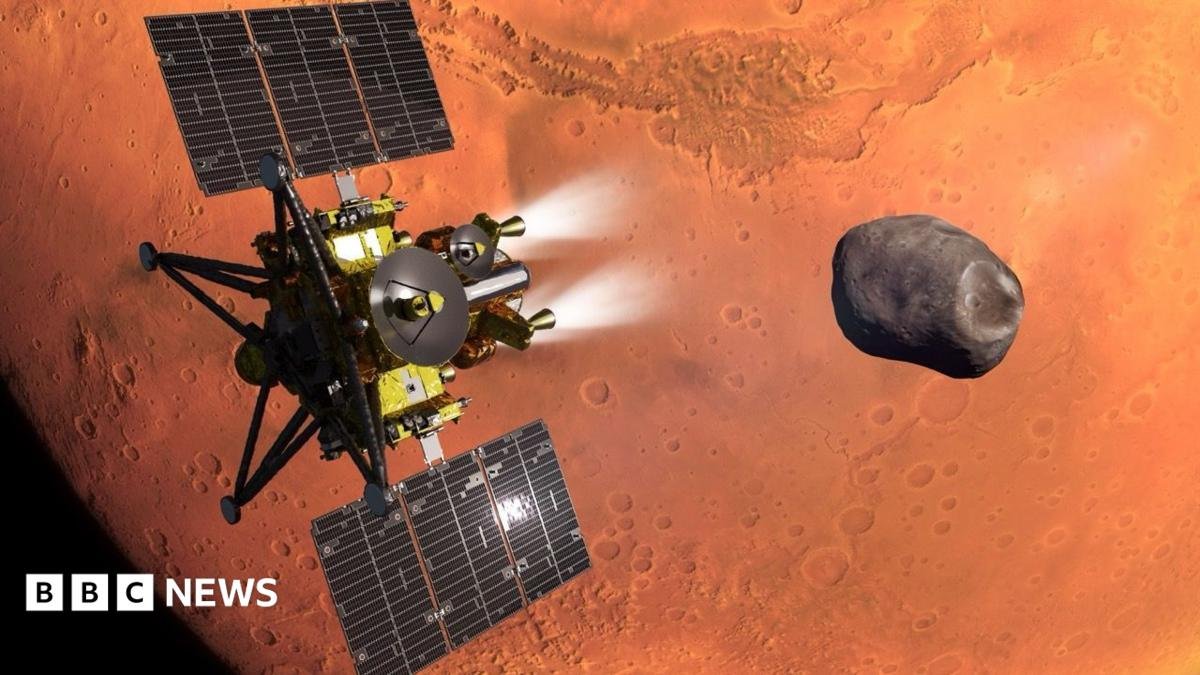
Japan has launched a mission to Phobos to collect moon dust and bring it back to Earth by 2031.
A new spacecraft recently launched from Japan. It travels toward Phobos, a moon of Mars. The mission aims to collect dust and bring it home.
Also, this marks a historic effort. No mission has ever returned a sample from Mars or its moons for study.
Next, the craft will arrive at the moon in August 2027. The Japanese Space Agency leads this bold project. Experts hope to solve mysteries about how these moons formed.
Meanwhile, the team will study both Phobos and Deimos. These moons look like small, lumpy potatoes. Phobos is only 12 miles across.
After that, the craft will deploy a small rover. Landing on a tiny moon is very difficult. The moon has very little gravity of its own.
However, the nearby gravity of Mars makes the landing tricky. The rover will first scout for a safe landing spot. Then, the main craft will touch down.
Finally, a robotic arm will gather 10 grams of dust. This material will travel back to Earth in 2031. It will land in the Australian desert.
Still, scientists feel excited about this small amount. Even tiny grains provide great data. They will analyze the chemistry to learn the moon's history.
Also, the samples might contain pieces of Mars itself. Impacts on Mars often spray rocks into space. Some debris likely landed on Phobos over time.
Now, researchers compare two main theories. Either a giant impact created the moons, or Mars captured passing asteroids. The results will reveal the truth quickly.
Finally, this mission provides a unique chance. Martian meteorites on Earth are often dirty. These new samples will remain clean and untouched by our air.