

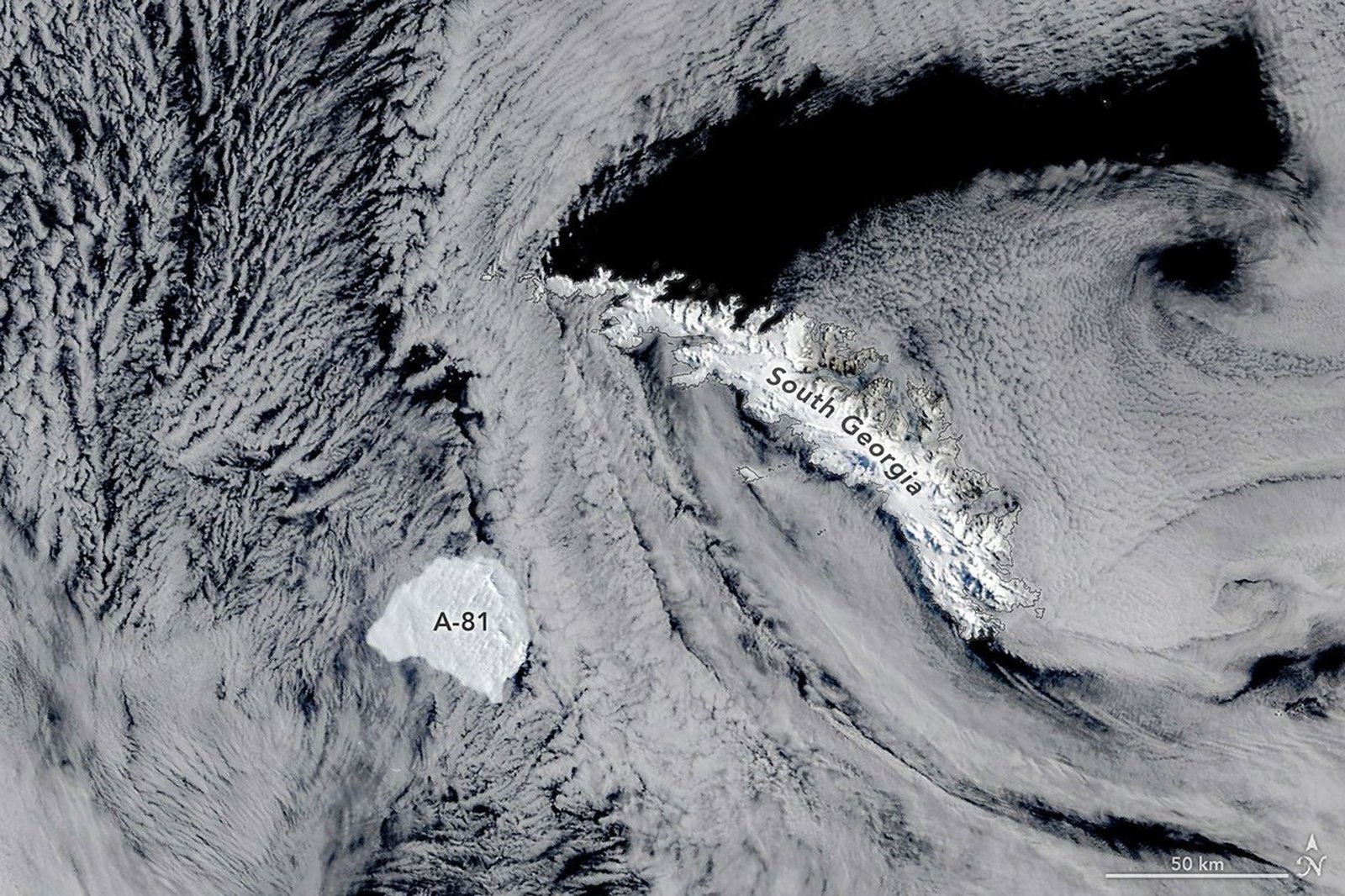
Iceberg A-81 traveled thousands of miles from the Antarctic Brunt Ice Shelf to the island of South Georgia. It is now moving slowly near the coast.
Some icebergs stay near Antarctica for many years. Others drift north away from the continent quite quickly. Iceberg A-81 recently completed a long journey from the Weddell Sea.
Also, the massive block of ice broke away from the Brunt Ice Shelf in January 2023. It covers about 1,550 square kilometers. This size equals roughly 600 square miles.
After breaking free, the ice spent three years moving through the Weddell Sea. Ocean currents pushed the berg along the coast. It finally reached the Antarctic Peninsula by May 2026.
Next, the iceberg traveled north into the Scotia Sea. By late October 2026, it neared the remote island of South Georgia. It traveled 2,300 kilometers from its original home.
Meanwhile, NASA satellite images show the berg near the island on October 20. Its speed slowed down as it approached the area. It seems to be bumping against the underwater shelf.
However, this is not the first time icebergs have stopped here. Iceberg A-23A also hit the shelf in 2025. It eventually broke into smaller pieces after getting stuck.
As for the origin of A-81, it took a long time to form. A large crack called Chasm 1 remained stable for 35 years. It started growing again around 2012.
Then, the crack widened significantly by 2019. Scientists expected a break for several years. The ice finally snapped off the shelf in 2023.
Finally, experts watch the Brunt Ice Shelf very closely. It recently lost several large icebergs in a short time. This shelf also hosts the important Halley Research Station.
Besides A-81, the shelf released iceberg A-74 in 2021. It also produced iceberg A-83 in 2024. Many other icebergs are currently leaving the Weddell Sea area as well.