

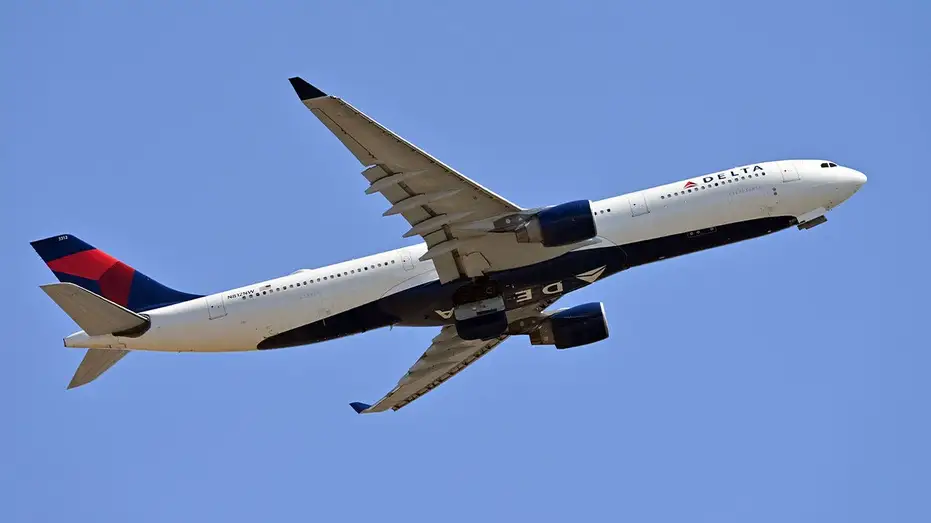
A Delta Air Lines flight from Paris to Seattle was forced to divert twice after a lavatory mechanical issue caused flooding in the cabin.
Travelers aboard a recent Delta Air Lines flight from Paris to Seattle experienced an exceptionally arduous journey that included two unplanned diversions. The flight, identified as Delta Flight 81, was operating an Airbus A330-900 with 209 passengers and 13 crew members on board when the journey was abruptly interrupted. The disruption began shortly after departing from Paris-Charles de Gaulle Airport on August 13, when the flight crew identified a significant mechanical issue originating from one of the aircraft's onboard lavatories.
As the situation within the cabin escalated due to the leaking lavatory, the pilot made the decision to divert the flight toward London Heathrow Airport. During the approach to the London hub, the crew found it necessary to declare an emergency with air traffic control. This measure was taken primarily because the aircraft was required to perform an overweight landing, necessitating priority handling and additional coordination with ground crews to ensure the safety of everyone on board.
Despite the tense nature of the emergency declaration, the aircraft touched down at Heathrow without further incident. Passengers were held as maintenance personnel attempted to rectify the mechanical failure. Delta later issued an apology for the situation, acknowledging that the experience fell short of the airline's standard service expectations and emphasizing their commitment to transporting passengers to their destinations safely.
Following the completion of maintenance efforts at London Heathrow, the aircraft was cleared for departure. However, the initial delay caused . Airline regulations strictly govern the number of hours flight crews are permitted to work, and the extended time spent dealing with the mechanical issue meant that the original crew could no longer safely complete the full flight path to Seattle.
To navigate these legal and safety-mandated duty time constraints, the airline opted for a secondary diversion. Instead of attempting a direct trans-Atlantic flight to the Pacific Northwest, the aircraft was rerouted to John F. Kennedy International Airport in New York. This decision allowed the carrier to manage the crew's operational limits while ensuring that the aircraft and its passengers remained on a path toward the final destination.
The logistical complexity of this rerouting meant that the 209 passengers were required to clear U.S. Customs at the New York airport before they could finally proceed on the last leg of their journey to Seattle-Tacoma International Airport. While Delta has not released specific technical details regarding the nature of the lavatory failure or the exact maintenance procedures performed in London, the incident serves as a reminder of the intricate safety protocols that govern modern commercial aviation.
The ordeal left passengers stranded for several hours, transforming a standard international flight into a multi-stop itinerary that spanned two continents and multiple time zones. For those on board, the experience involved significant uncertainty as they were diverted first to the United Kingdom and then to the East Coast of the United States. Such occurrences, while rare, highlight the challenges airlines face when mechanical failures occur mid-flight over international waters.
Airlines prioritize aircraft safety above all else, which often results in these types of precautionary measures. Declaring an emergency for an overweight landing is a standard safety procedure intended to ensure that the plane can land as quickly as possible when a fault is detected. passengers, the flight crew followed established industry protocols to mitigate risk.
Moving forward, the incident raises questions about the maintenance of long-haul aircraft and the impact of unexpected equipment failures on global travel schedules. Delta Air Lines has maintained that their primary focus remains on the safety of their customers and the efficiency of their operations. While the inconvenience caused afe landing and eventual arrival of the flight in Seattle were the successful outcomes of a highly managed emergency response.