

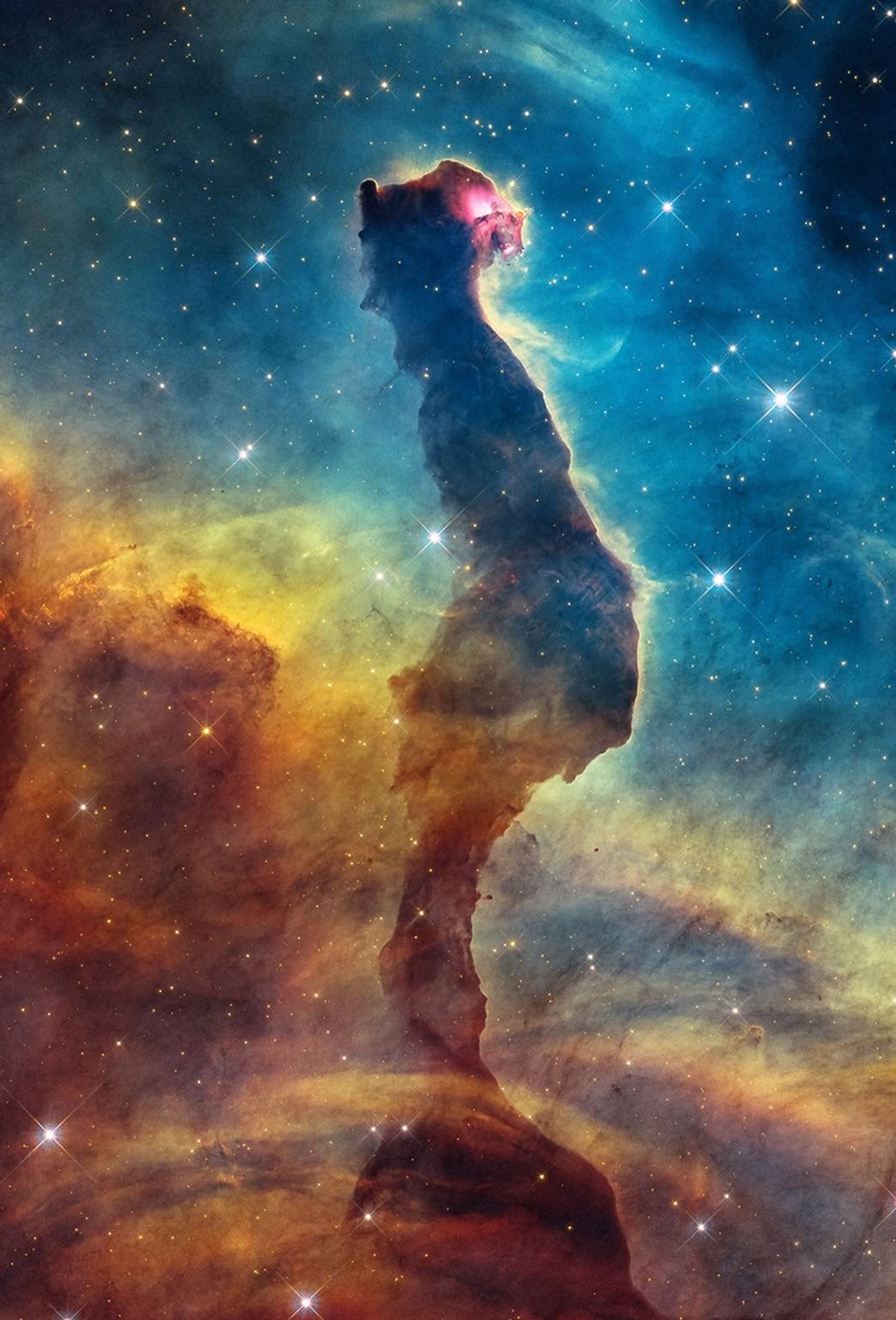
NASA's Hubble and Webb telescopes captured a unique star-forming region known as the Cat's Head Nebula located in the Carina Nebula.
NASA’s Hubble and James Webb space telescopes recently captured a stunning star-forming region. This area exists within the massive Carina Nebula. It sits about 7,500 light-years away from our planet.
Scientists call this small section the Cat’s Head Nebula. Its shape looks like a cat sitting with its back to us. The head turns to the right and features a bright, glowing eye.
Also, this nebula is only a temporary sight. It will eventually change as stars grow and evolve. Still, the region provides astronomers with vital information about how stars form.
Next, experts believe massive stars sculpted this shape over time. Intense winds and radiation from these stars push away gas and dust. Denser material resists this erosion for now, creating the unique feline pillar.
Hubble’s visible-light view shows a dark brown pillar of dust. The glowing red eye likely represents a young, hidden star. A hazy yellow ridge shows gas reacting to radiation from nearby massive stars.
Meanwhile, Webb’s infrared images reveal different details. The nebula looks more transparent in these views. Webb shows delicate wisps of gas and dust exposed to intense stellar radiation.
Also, Webb’s high-resolution camera captures many background galaxies. It peers through our own Milky Way to reveal deeper space. These images help scientists understand the complex surface of the nebula.
Finally, mid-infrared light shows warm dust and carbon molecules. These molecules create intricate strands and structures. A bright yellow source to the right appears to be an infant star.
NASA and its international partners manage these powerful telescopes. Hubble has served science for over thirty years. Webb continues to explore the origins of our vast universe.