

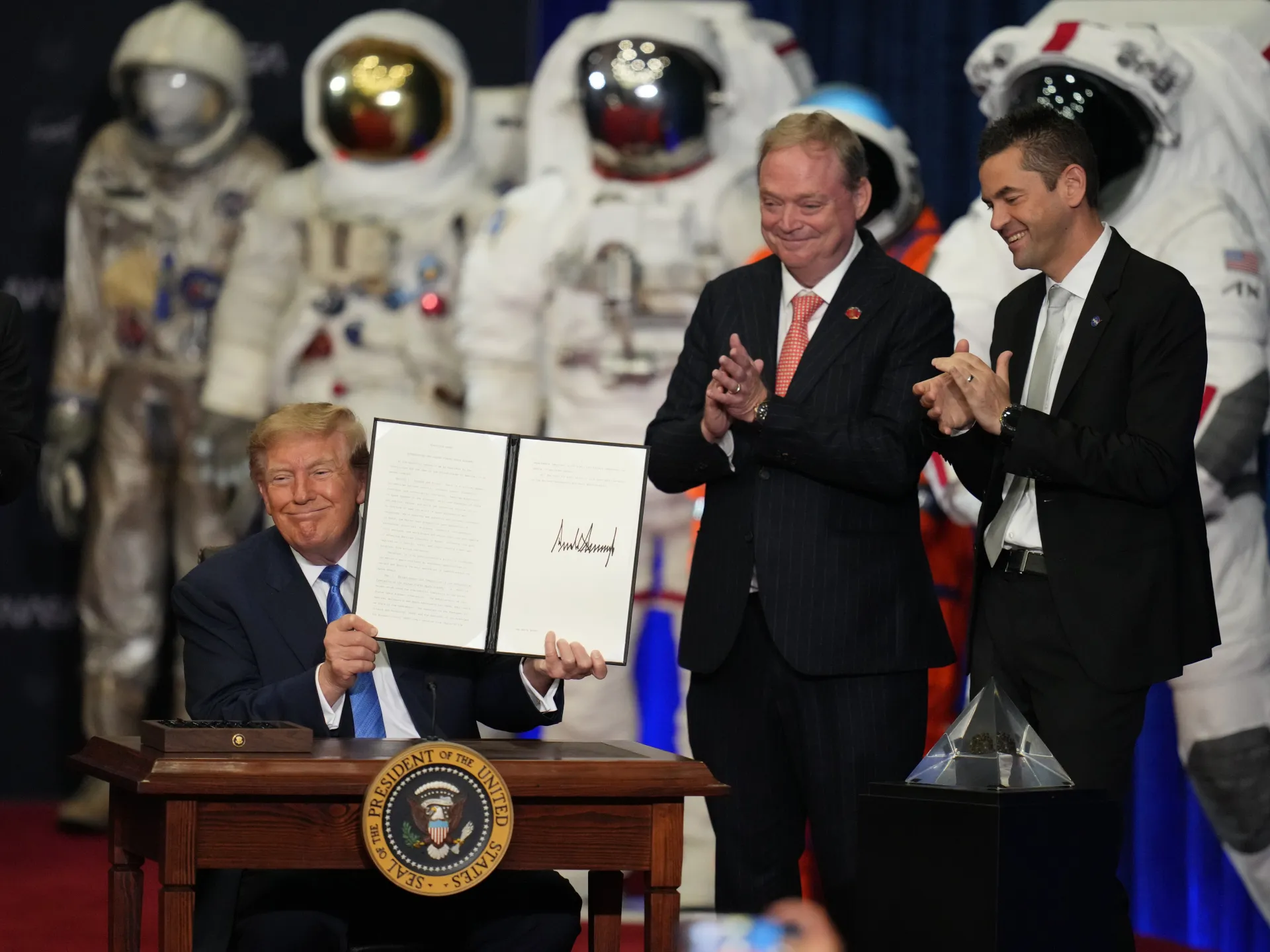
President Trump has signed an executive order to establish the US Space Academy, a new institution aimed at training personnel for military and civilian space missions.
President Donald Trump has officially initiated the creation of the United States Space Academy, a new institution designed to cultivate the next generation of leadership in space exploration and national security. The announcement, delivered at the Johnson Space Center in Texas, marks a significant shift in how the federal government approaches the training of personnel dedicated to extraterrestrial endeavors. During an event honoring the Artemis II mission crew, the President emphasized that the academy is intended to be a premier facility, operating with the same prestige and rigor as established service academies like West Point and Annapolis.
e for talent that will serve the United States Space Force, NASA, and the growing civilian space flight sector. The President noted that the academy would serve as a central hub for attracting and training the country’s most promising individuals, ensuring that the United States maintains a competitive edge in space-related industries and defense capabilities for decades to come.
To oversee the development of this ambitious project, an executive order has established a presidential commission tasked with advising and assisting in the academy’s foundational stages. This high-level group is set to be led Secretary of the Air Force Troy Meink, and White House Office of Management and Budget Director Russ Vought. Their involvement signals the high strategic priority placed on the institution
The commission is expected to handle the logistical, educational, and structural requirements necessary to bring the academy to life. nch, the government intends to ensure that the curriculum and training protocols meet the high standards required for both military service and civilian aerospace advancement. This inter-agency cooperation is meant to streamline the development process and guarantee that the academy is equipped to handle the rapid technological evolution of the space sector.
The creation of the Space Academy is the latest in a series of initiatives prioritized the Space Force as the sixth branch of the United States military underscored a shift in national security doctrine, with the administration citing the need to protect assets and deter aggression in what is often described as the "ultimate high ground." This latest move to create an educational institution further codifies the commitment to treating space as a permanent, critical domain of American activity.
The announcement coincided with a ceremony honoring the Artemis II astronauts—Reid Wiseman, Victor Glover, Christina Koch, and Jeremy Hansen—who were presented with the Congressional Space Medal of Honor. Their successful mission, which involved a journey around the far side of the moon, serves as a benchmark for the capabilities the new academy will seek to replicate and expand upon. While the future of the broader Artemis program has faced technical hurdles, including recent adjustments to mission objectives following safety concerns, the academy remains a central pillar of the administration's long-term vision for lunar exploration and beyond.
The training facility will be tasked with preparing students for a complex future where the lines between commercial space exploration and national security continue to blur. With private enterprises such as SpaceX and Blue Origin playing increasingly vital roles in space flight, the academy's mission to support both civilian and military sectors is seen as a necessary adaptation to the modern space economy. Graduates are expected to emerge with a unique skill set capable of navigating the technical, legal, and operational challenges inherent in modern space flight.
As the commission begins its work, the administration remains focused on the symbolic and practical implications of this move. commitment to exploration while addressing the increasing demand for specialized labor in a rapidly expanding field. The academy is intended to serve as a beacon for scientific advancement, ensuring that the United States remains at the forefront of global aerospace achievement for the foreseeable future.